Sun Tunnels in Milton Keynes
A sun tunnel is a skylight for the room that has no roof of its own: a landing, a hallway, a bathroom with another storey above it. We fit them, finish the ceiling, and write the quote down.
Where a sun tunnel is worth having
A sun tunnel suits a room that sits under the roof but not against it. These are three places it does the job.
-
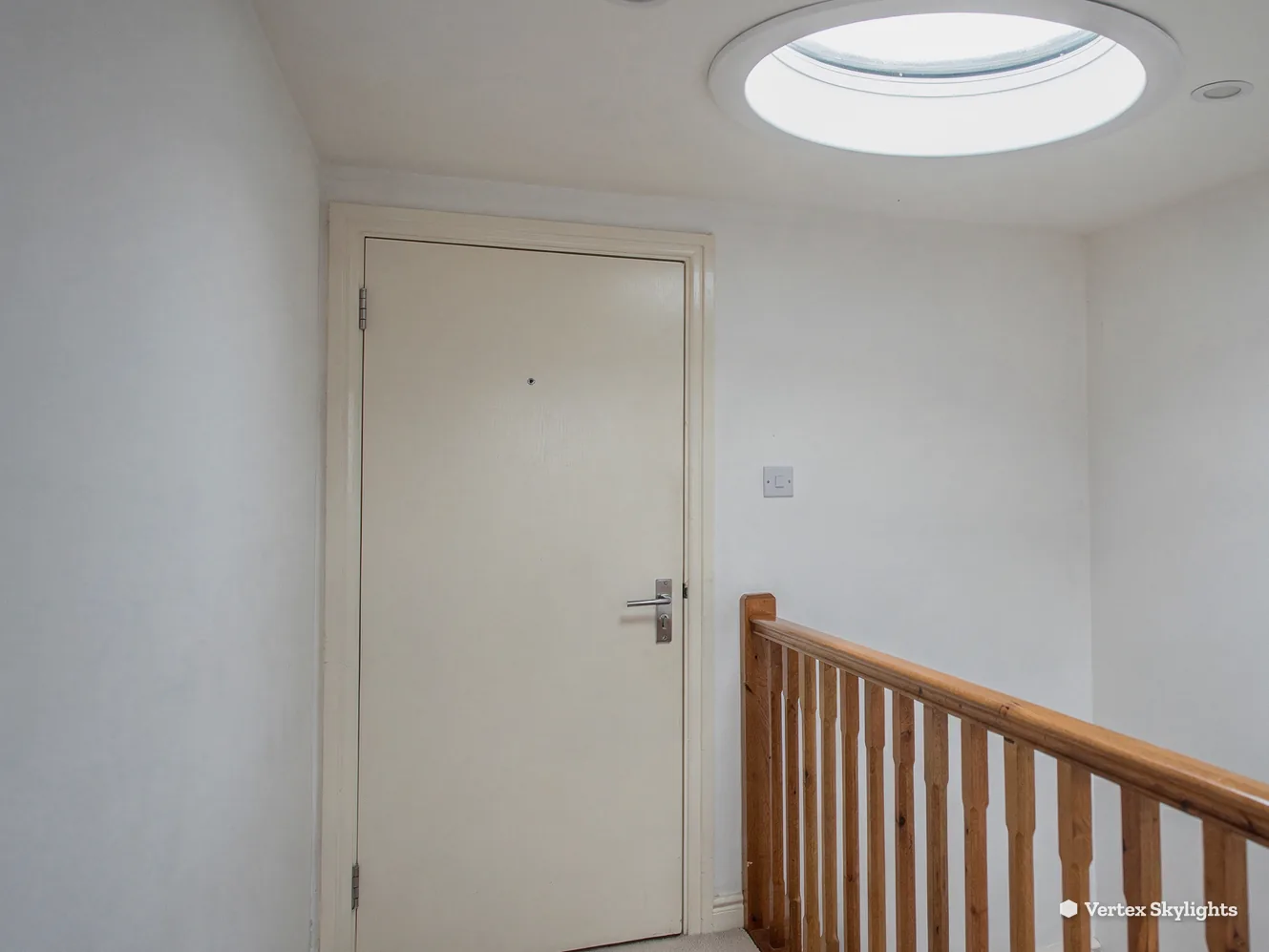
A landing with no window
The dark middle of the first floor, where a bulb has burned all day since the house was built.
-
A bathroom under the loft
A room with no outside wall, or one that looks onto a neighbour, lit from the sky without a window to cover.
-
A hallway in a bungalow
A short run from roof to ceiling, so the daylight reaches the floor with little lost on the way.

Built to last
- We survey before we price
- Your written quote does not change on the day
- Building Control notification handled
- 10 years on our workmanship, in writing
Sun tunnels, start to finish
Getting daylight into the rooms that have no window
Some rooms have no outside wall that could take a window. A sun tunnel borrows the sky instead. These are the problems it solves, and what it takes to fit one well in Milton Keynes.
The room has no window to add
Some rooms sit at the heart of the house, and every wall around them belongs to another room.
Sideways
A landing, a hallway or a bathroom in the heart of a house is wrapped by other rooms. There is no outside wall to cut a window into. The light switch goes on in the morning and stays on until bed, and the space feels like a corridor in a building site even when it is freshly decorated.
Where the room does have an outside wall, the view may be a neighbour's bedroom window or a fence a metre away. A side window there lets in glare and gives away privacy at the same time.
Straight up
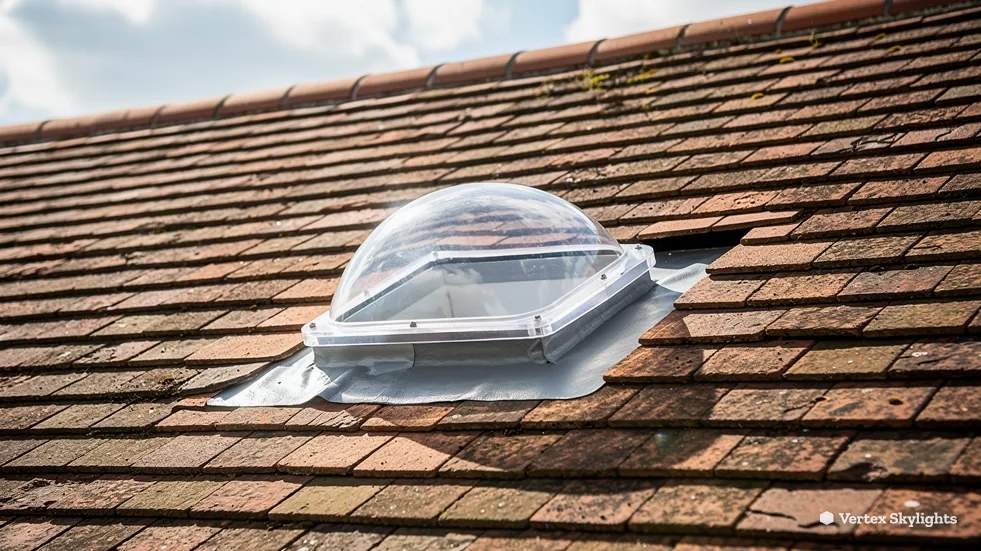
A sun tunnel, sometimes called a light tube, takes a different route. A clear dome sits on the roof and catches the sky. A reflective tube carries that natural light down through the loft space to a diffuser in the ceiling, which spreads it into the room below. Straight up is clear: nothing stands between the dome and the sky.
There is no glass at eye level, so there is nothing to overlook and nothing to curtain. What the ceiling holds is a soft round disc of daylight, shifting with the weather and the hour.
In the trade this is a small rooflight with a long throat; homeowners call the whole thing a skylight, a sun pipe or a light tube. Whichever word you use, the idea is the same, and a well-made one such as the VELUX tunnels is built from a dome, a flashing, a tube and a diffuser that arrive as a matched set.
It is a quiet fit for residential homes of every age. The opening in the roof is far smaller than for a roof window, so a sun tunnel can go where a roof window would not fit between the rafters, or where the ceiling below is not directly under a sloping roof.
A wall window faces a tree, a neighbour, a fence or a wall. Look straight up and the way is clear, and a sun tunnel is the smallest, quietest way to use that. You do not need to give up wall space, move furniture or lose privacy to get it.
What you see from inside is the diffuser, a flat frosted disc set into the ceiling. On a bright day it glows like a pale lamp. On a grey day it still lifts the floor, because the dome gathers whatever daylight there is. At dusk it fades gently, the way a window does, so the room follows the day rather than fighting it.
Because the tube is sealed from the loft, no dust, draught or insects travel with the light. The diffuser sits flush to the ceiling plane and takes a wipe with a cloth. For an older house with a narrow landing and a steep stair, that is a tidy answer to a long-standing problem.
Consider the way the room is used over a week. A room crossed a dozen times a day, always in passing, benefits from a light that is simply there, and a room used at the edges of the day gets a soft glow when the weather allows. A bright space also changes how the rest of the house feels as you walk through it.
The roof is a long way above the ceiling
Daylight is easy to catch and harder to carry.
Sideways
A sun tunnel has to cross whatever lies between the roof covering and the ceiling of the room. In a bungalow that may be a short drop through the roof void. In a two-storey house it can be a longer climb through the loft, past trusses and across to a landing that is not directly below the best spot on the roof.
Every metre of tube and every bend gives the light a little less to work with. A tunnel planned from the street, without a look in the loft, can promise a bright disc and deliver a dim one.
Straight up
This is why the survey starts in the roof void. A rigid tube has a mirror-finish lining and carries light furthest on a straight run, so it is the choice when the drop is direct. A flexible tube bends round a rafter, a purlin or a water tank, and is the answer when the route has to dodge something. It carries a little less light for the same length, which is why we keep the bends to the fewest the roof allows.
We measure the run from dome to ceiling, note what is in the way, and pick the tube diameter and type to suit. A wider tube moves more light, and a short straight tube is brighter than a long bent one.
Words you will hear
Dome
The clear dome fixed to the roof, which catches daylight and sheds rain.
Flashing
The shaped collar that seals the dome to the roof covering so water runs away from the opening.
Rigid tube
A straight, mirror-lined tube that carries daylight furthest over a direct run.
Flexible tube
A bendable tube that can curve round roof timbers, at the cost of a little light.
Diffuser
The frosted disc in the ceiling that spreads the daylight into the room.
Run
The length of tube between the dome on the roof and the diffuser in the ceiling.
Where the roof is a pitched tile or slate covering, the dome sits on a flashing made for that covering, so rain runs over and around it. On a flat roof, the tunnel starts from a short base fixed to the deck. The same logic as for any flat roof rooflight applies: the base is raised above the water line, and the covering is dressed up to meet it.
If the house has a flat-roofed extension with a hallway sitting behind it, the tunnel is a neat way to light the dark link between old and new. The tube is short and the dome is out of sight from the garden.
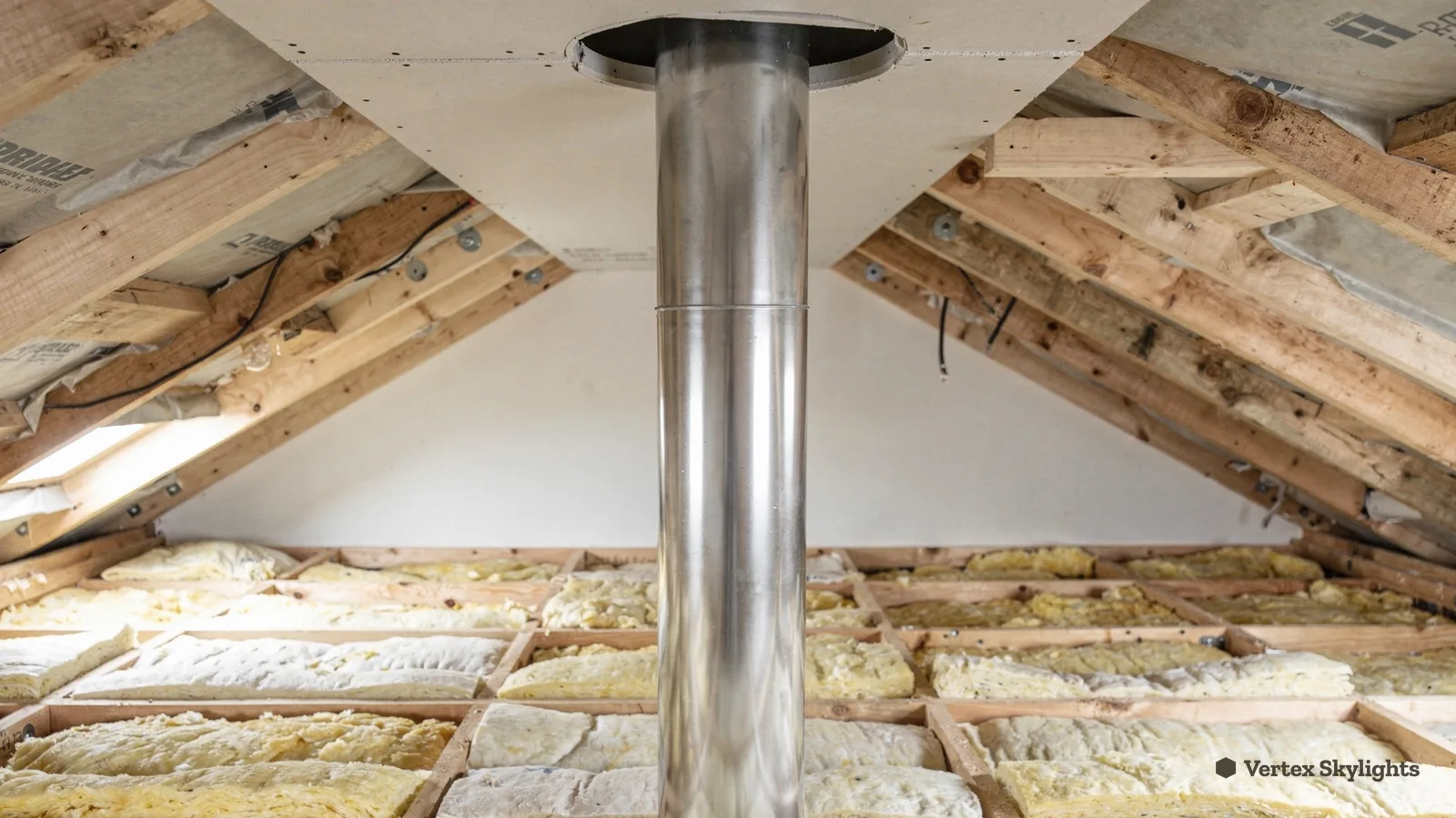
Run length matters because daylight is lost a little at each reflection inside the tube. The mirror lining returns nearly all of what it receives, but the more bounces, the less arrives. This is why we survey the loft first. A tunnel that drops straight down two metres of roof void is a different job from one that must wander across the whole house.
Diameter matters too. A narrow tube suits a cloakroom or a small landing. A wider one suits a hallway or a bathroom with a long wall. We measure the room, look at the roof, and match the two, so that the diffuser you see is the right size for the ceiling it sits in rather than lost in it or crowding it.
The dome itself is a clear or lightly textured cap that sheds rain and catches the sky from every direction. On a tile roof it sits slightly proud of the covering; on a slate roof it uses a flashing shaped for slate. We pick the flashing to suit the roof it joins, which is what keeps the opening watertight in the first autumn and every one after.
Sun tunnels come from several makers. VELUX and FAKRO both make sun tunnels, each with its own range of dome, tube and diffuser sizes, and specialist makers offer others. We choose the make and the tube at the survey to suit the run, rather than starting from a brand.
Insulation matters in the loft. A tube that crosses cold space is wrapped so the warm air from the room below does not meet a cold surface and turn to water. That small step is what keeps a tunnel dry inside, and it is part of the fitting, not an extra.
A sun tunnel, a roof window or a flat pane?
All three put glass in the roof. They do different jobs.
Sideways
It is easy to ask for a skylight and be handed the wrong one. A roof window opens up a view of the sky and needs a big hole in the roof and a deep reveal in the ceiling. A flat rooflight suits a flat roof and needs an upstand. A sun tunnel needs neither, but it gives light only, with no view and no way to open.
Choosing between them from a catalogue, with nothing but a photograph of the finished room, is how people end up with a window where a tunnel was wanted, or the other way round.
Straight up
We start from the room and work back. If you want to look at the clouds and have the roof pitch and floor height to allow it, a roof window is the better piece of glass, and our answer on whether a sun tunnel is the same as a roof window sets out the difference. If the room is a landing, a cupboard-sized bathroom or a hallway, and you want the room brighter without a view, the tunnel is the lighter touch.
A good plan can be a mixture: a roof window in the loft bedroom, a tunnel in the landing below it, and a rooflight over the kitchen extension. Each gets the glass it suits.
| Option | Gives | Suits |
|---|---|---|
| Sun tunnel | Daylight only, no view | Landings, halls, bathrooms |
| Roof window | Light, view and opening | Loft rooms, pitched roofs |
| Flat rooflight | Wide light over a flat roof | Extensions, kitchens |
| Roof lantern | Light from all sides above | Larger flat-roof rooms |
For a loft conversion, the tunnel is a good companion. The conversion itself needs roof windows for daylight, air and a view. The landing that serves it, and the stairwell that has just lost its window to the new floor, are the places a tunnel picks up.
If you want to see what sits on the shelf, our page on VELUX windows covers the wider range of roof windows and where each fits.
A sun tunnel is also a gentle choice for a house where a roof window is not wanted. A roof window opens up a large part of the slope, changes the look of the front elevation, and needs a deep lined recess in the ceiling. A tunnel dome is a small round cap on the roof, and a small round disc in the ceiling. For some houses and some streets, that is a better fit for the look of the place.
Neither choice is final. If you start with a tunnel on the landing and later convert the loft, the tunnel carries on working or can be moved. If you start with a roof window and decide the landing also needs light, the two sit happily in the same house. We plan so that one job does not get in the way of the next.
It also helps to think about the room as a set of tasks. A room where you read, cook or shave wants strong light at a table or a mirror; a room you pass through wants a general glow. A tunnel suits the second kind best. For the first, a bigger piece of glass may deserve a look as well, and that is a conversation for the survey.
The installation process: a hole in the roof and the ceiling
A tidy sun tunnel is mostly a tidy plan.
Sideways
Anything that goes through a roof must be watertight from the first shower. A tunnel also crosses the loft, where insulation, wires and pipes may be in the way, and then it breaks through a ceiling you have just decorated. The worry is mess, a leak, or a hole left half-finished while a tradesperson moves on.
A badly flashed dome is where leaks start, and an uninsulated tube through a cold loft is where condensation starts.
Straight up
The process is simple and we keep it that way. First, a free survey goes up into the loft, finds the clear route and agrees the position of the diffuser with you. Then you get a fixed written quote that stays put when we arrive. On fitting day we lift the roof covering, set the flashing and dome so the covering laps over it, run the tube through the loft with the joints taped, wrap it where it crosses cold space, and cut the ceiling for the diffuser.
Afterwards we finish the inside: the edge of the ceiling opening is made good with plastering where it needs it and the diffuser is set neatly, ready for paint. An ordinary-sized rooflight needs a day or two to fit, and a sun tunnel sits at the quick end of that.
Before the survey
- Which room needs the light, and does it sit under the roof?
- Can we reach the loft above it?
- Is the roof tiled, slated or flat?
- Do you want a room you can darken for sleep?
- Is there a light fitting you would like to keep?
Every dome we set is weatherproof and fitted to the roof covering, not just sealed round with mastic. Because the dome is small, there is far less roof to open than for a roof window, and no new structural timber to trim in most cases. If the job needs to be notified to Building Control, that is our paperwork, and the finished work meets the Building Regulations in force. Our 10-year workmanship guarantee in writing covers the work.
For the day itself, our answer on how long a skylight takes to fit sets out the fitting stages.
On the day, the order is the same each time. Dust sheets go down from the front door to the room. The ceiling is opened from below and the roof from above, and the tube goes in between. The dome and flashing are set and checked first, because the roof must be closed against the weather before anything else is done. Then the tube is joined and supported, the ceiling is finished, and the diffuser goes in last.
Where a loft is boarded or full of belongings, we ask you to clear a path, and we tell you which part. Where the loft is insulated, we put the insulation back round the tube, so the loft keeps its warmth. Where wiring or pipework crosses the best line, we plan round it rather than disturb it.
A written quote means you know the work before it starts. It names the product, the tube length and type, the roof covering to be disturbed and the finish inside, and the figure stays put when we arrive. If you decide to add a light kit or move the diffuser, we say so and agree it before any work begins.
Afterwards you get the details of the guarantee in writing, along with aftercare and maintenance notes: wipe the dome from the outside with water when you next clean the gutters, and wipe the diffuser with a damp cloth. A sun tunnel asks for very little. If a dome ever yellows or a tube is damaged, we can replace the set and finish the ceiling to match.
Lighting, ventilation and the dark at night
A tube gives you daylight; the rest is detail.
Sideways
A sun tunnel does one thing very well and does not do every job a window does. A window opens for fresh air; a tunnel is sealed. A window has a blind you can draw; a tunnel throws a disc of light whether you want it or not. And at night, a bare diffuser is a dark circle in the ceiling.
In a bathroom the missing extra is air, because steam still has to leave the room. In a bedroom landing it may be the glow at dawn.
Straight up
The answer is to plan the extras with the tunnel. For ventilation and fresh air, a bathroom keeps its extractor fan, and the tunnel does not replace it. Some makers sell a kit that adds a light fitting inside the tube, so the same diffuser gives light after dark, and we can fit that where it is wanted.
Energy limits for roof glass
- 1.4 W/m²K
- ceiling that Approved Document L sets for roof windows in an existing home, or a WER of band B
- 2.2 W/m²K
- ceiling set for rooflights in an existing home by Approved Document L
The Building Regulations set the energy limits that the glass must meet when roof glazing is fitted to an existing home: Approved Document L, Table 4.2, gives the limits above. We check the rating of the unit against the right line before we quote, and we explain which line applies to which product.
Where the glass can be bespoke, such as a roof window beside the tunnel, it can be made to measure. The tunnel itself comes in standard tube sizes, chosen to suit the run.
Think of the finished room as the test. A wet room with a sun tunnel and a good extractor fan feels airy by day and dry afterwards. A room with a tunnel and a ceiling light feels bright in the daytime and welcoming at night. A tunnel over a pale ceiling bounces light to the walls and makes the whole house feel less like a corridor. The tunnel is the daylight part of the plan, and the fittings you already have do the rest.
If a room is to be used at night with the door open to a bedroom, a pale glow may or may not be wanted. Some people like the soft light on a dawn landing, and some would rather not have it. The honest answer comes from standing in the room when the light matters most, then telling us how it feels. We can then place the tunnel to suit, or suggest the roof window instead.
Condensation is also worth a word. A tunnel that is correctly wrapped and sealed does not sweat. A tube left bare across a cold loft can. We fit the wrap as part of the job, and the joints are taped, so the light travels in a dry, sealed pipe.
A sun tunnel takes no blind, though some makers offer a dimmer or shutter kit that closes off the tube. If a room has to go dark in the morning, say so at the survey. Where a room needs full blackout, a roof window with a blackout blind is the surer choice, and the tunnel keeps the daylight in the hall or landing.
Choosing, planning and getting it fitted
From a dark landing to a bright one in a few clear steps.
Sideways
Everyone starts with a room they dislike and no idea whether a sun tunnel will help. The questions run ahead: does it need planning permission, will the loft allow it, which tube, what will the ceiling look like, who finishes the plaster, and what happens when something fails after fitting?
Those are fair questions and they do not need an expert to ask them. They need someone to look at the roof.
Straight up
Planning is a short conversation. Roof windows and rooflights that stay within the roof slope can fall under permitted development, and a sun tunnel's dome sits low, but flats and listed buildings follow other rules, as do homes under an Article 4 direction, and living in a conservation area is not the same as losing those rights, though an Article 4 direction can take them away. Our Milton Keynes planning guide shows where to check, and the planning team at the council will tell you about your street.
We then do the rest: the survey, the fixed quote, the fitting, the Building Control notification where it applies, the tidy finish inside, and a written guarantee. We also install and replace, so an old dome that has yellowed or a tube that has seen better days can be changed for a new set, with the same finish inside.
Verdict: where a landing, hallway or bathroom has no outside wall, a sun tunnel is the lightest way to bring the sky indoors; for a loft room that wants a view, a roof window is the better glass.
Areas covered around Milton Keynes
Our sun tunnels go into homes in Milton Keynes and in the market towns and villages round it, from Newport Pagnell and Olney to Buckingham and Leighton Buzzard, and we also take on small commercial jobs. If you want to know what the work costs before you book, our guide to what moves a sun tunnel's price explains the things that change a quote, and the survey turns that into a figure.
The full list of towns and villages is on our areas page.
Replacing an old or failed sun tunnel
Replacement is a job we take on as readily as a new fit. An old dome that has yellowed or crazed, a flashing that no longer sheds water, or a tube that has come apart at a joint can be taken out and a fresh matched set fitted in the same opening, with the ceiling finished to match. We look at the old unit first, because a failed joint, a failed flashing and a failed dome call for different answers.
If you are unsure whether the roof will take any glass at all, start with our guide to putting a skylight in any roof. To compare daylight across the options, see how much daylight a rooflight gives.
A short list of what the survey covers may help. We stand in the room and look up. We go into the loft and trace the route. We note the roof covering, the rafter spacing and anything in the way. We measure the run and choose the tube. We check where the diffuser will sit in the ceiling. We talk through extras: a light kit, a different diffuser, a nearby roof window. And then we write it all down in a quote that stays put on fitting day.
The survey is free. You are under no pressure to book, and a clear written quote is yours to keep. If the roof will not take a tunnel where you want it, we say so and suggest a better position, or a different product.
There is room, too, for the long view. A house changes over the years. A landing that is dark now may be part of a loft conversion in ten years. A bathroom may be refitted. A tunnel is a small, tidy first step that stays useful through all of it, and it is easy to move or replace when the house moves on.
The roof, the loft and the ceiling are all done together in a day or two of work, finish inside included. To see what shapes a figure, our guide on sun tunnel costs is the place to read first, and the survey turns it into a number you can hold us to.
Sun tunnel questions, answered
What is a sun tunnel, and is it the same as a light tube?
Yes. A sun tunnel, a light tube and a sun pipe are the same product: a roof-top dome, a reflective tube and a ceiling diffuser. Our answer on what a sun tunnel is goes through each part.
How much light will it give my room?
It depends on the roof's aspect, the length and bends of the tube, and the size of the room. A short straight run into a small room is the brightest case. Our answer on how much light a sun tunnel gives explains what changes it, and we look at the loft before we promise anything.
Where do sun tunnels work best?
In rooms under the roof that have no window or only a poor one: landings, hallways, bathrooms, cloakrooms and utility rooms. The guide on where sun tunnels work best covers each room and what to watch for.
Can a sun tunnel replace the lights altogether?
It can cut the hours the lights are on in the daytime, but it is not a replacement for a light fitting at night. Where you want one in the same place, a light kit can share the diffuser. Ask at the survey and we will say what suits your room.
Free survey
Book your free survey
No obligation. We survey before we price.
Or WhatsApp 07880 284133