Electric Opening Rooflights in Milton Keynes
A skylight that opens by remote, and shuts itself when the rain starts. Fitted, wired, finished inside and signed off to current Building Regulations.
Where an opening rooflight earns its place
It suits any room where warm air gathers and a window in the wall cannot reach it.
-
Kitchen extensions
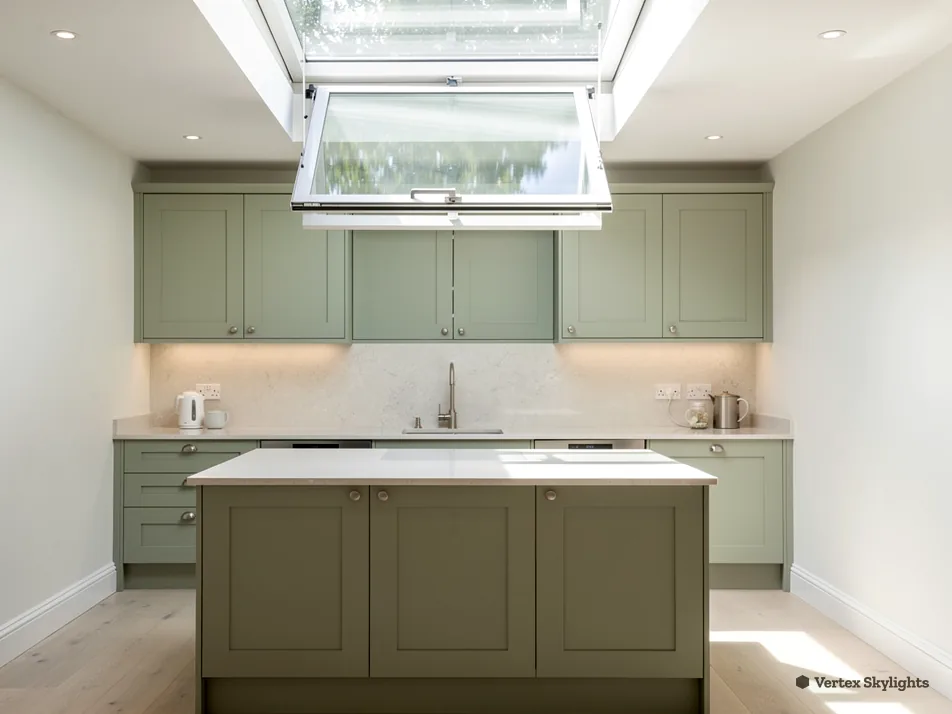
Cooking heat and steam rise to the ceiling. An opening rooflight lets them leave from the highest point of the room.
-
Landings and stairwells
The top of a stair is where warm air pools and no wall window can be fitted. An opening rooflight sits within reach of the remote, not of a pole.
-
Loft bedrooms and bathrooms
Hot air and shower steam have nowhere to go under a roof slope. An opening roof window gives them a way out.

Built to last
- We survey before we price
- Your written quote does not change on the day
- Building Control notification handled
- 10 years on our workmanship, in writing
Electric opening rooflights, start to finish
Getting an electric opening rooflight right in a Milton Keynes home
A fixed skylight brings in the sky. An electric one also lets the room breathe. These are the problems it solves, and what it takes to fit one well.
The room is warm and the air is stale
Warm air rises. Most windows are fitted nowhere near where it goes.
Sideways
On a warm afternoon the heat in a kitchen or an extension does not hang at head height. It climbs and collects against the ceiling, where no wall window can reach it. You can open every door and the room still feels close, because the hottest air is trapped above the line of the frames.
Cooking makes it worse. Steam, smells and heat rise together and settle under the ceiling, then drift back down onto the people below.
Straight up
An electric opening rooflight puts the opening at the top of the room, exactly where the warm air gathers. Raise it a few inches with the remote and the stale air climbs out through the roof while cooler air is drawn in at the doors and windows lower down. That is the idea behind ventilation from overhead: it works with the way air already moves.
It is also gentle. You are not opening a door onto the garden to move the air about, so the room stays private and quiet while it freshens.
Think about where a fixed skylight stops helping. It brings in light, but the air stays where it is. In a south-facing extension the glass can warm the room further, and a fixed pane gives that heat no exit. An opening rooflight changes the sum. The sun still comes in, and the heat it brings can leave again through the same opening.
This is the point of the straight up is clear idea too. A window in a wall faces whatever stands outside it, and the air it lets through has to find its way past. Overhead, nothing is in the way, so the opening gives the warm air a clean route to the sky. The view up is clear, and so is the path out.
In practice the room feels different within minutes. Raise the sash a few inches on a still afternoon and you can feel the draw, cooler air moving across the floor toward the doors as the warm air lifts away above. Close it again and the room is sealed and insulated like the roof around it. It is a simple, quiet way to change the air without changing the walls.
Opening rooflights also suit rooms that are used hard. A kitchen that cooks every evening, a bathroom with a shower in the morning and a utility room with a tumble dryer all make damp, warm air. Letting that out at the top reduces the damp that settles on cold surfaces, and so helps keep condensation down. It does not replace an extractor fan. It sits alongside one, and it is silent.
Homeowners call it an opening skylight. Installers say opening rooflight, and for a roof window on a slope the word is roof window. Both trade words describe the same idea: a fixed frame in the roof, a sash that lifts, and a small motor that does the lifting. The page on ventilating a room with an opening rooflight goes through how far to open it and when.
The window is out of reach
A skylight you need a pole to open is a skylight nobody opens.
Sideways
Manual roof windows have a bar or a cord and sometimes a long pole. Over a stair, a landing or a bathroom they sit at a height no one can reach comfortably. In a flat roof the problem is sharper: the lid may be fixed shut, or a heavy hand-wound arm sits on a ceiling too high to stand under.
So the window stays closed. A skylight that never opens is just a fixed one, and the room loses the one thing an opening roof light can add.
Straight up
An electric opening skylight removes the reach. A remote control or a wall switch does the work, and the motor lifts the sash smoothly to the angle you pick. Because opening takes a second, people actually do it, and the room gets a fresh breath every morning rather than a few times a year.
Controls come in a few forms. A handheld remote, a wall keypad and a smart control that talks to a phone are all routes to the same motor. We talk through which suits the household at the survey, along with where the switch will live on the wall.
Words you will hear
Sash
The part of a roof window or rooflight that lifts open, as opposed to the frame fixed in the roof.
Actuator
The small electric motor and arm that raises and lowers the sash when you press the button.
Rain sensor
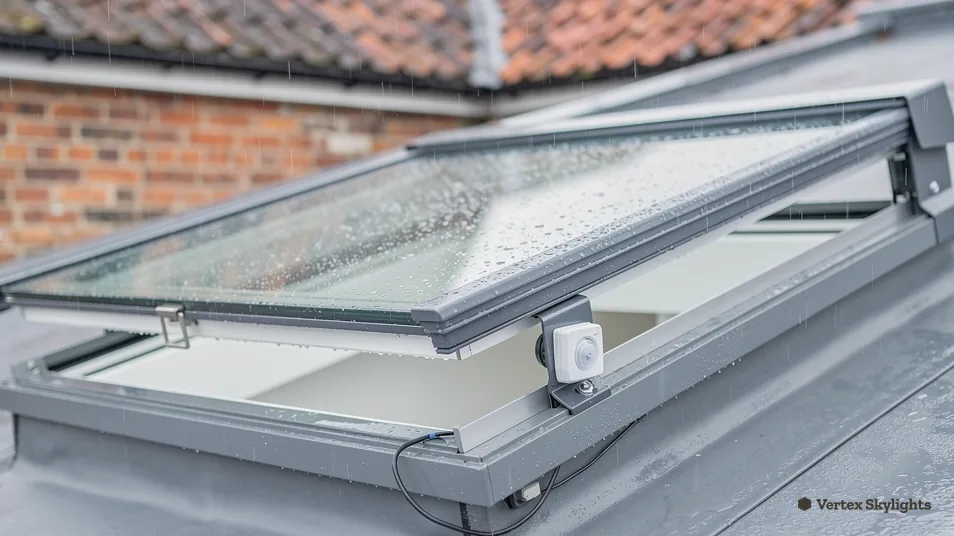
A small detector on the outside that tells the motor to shut the rooflight when raindrops land on it.
Upstand
The raised kerb a flat rooflight sits on, which lifts the glass above the water on the roof.
Control unit
The small box that takes power from the house and passes signals between the remote and the motor.
Smoke vent
A rooflight that opens automatically to clear smoke, a different product from a comfort-ventilation rooflight.
Power is the other half of the choice. Some opening rooflights run on the mains through a small control unit, some on low voltage from a transformer, and some use a solar-charged battery with no cable run at all. Each has a place. Where a cable can be hidden above a ceiling that is being finished anyway, mains or low voltage is neat. Where the finished ceiling is already in place and a chase would be messy, a battery or solar model can be the cleaner answer. A free survey is where we look at the route and say which fits your house.
It helps to picture the daily routine. You come downstairs, press a button on the wall, and the landing rooflight lifts a few inches. You go out for the day and the sash stays where you left it, or closes on a timer or the rain sensor. When you come back the stairwell is fresh instead of stuffy. No pole, no stepladder, no climbing onto a bed to reach a handle.
The same ease matters in a bathroom, where a window above a bath is awkward to reach with wet hands, and in a bedroom under the slope where a roof window sits above the head of the bed. A remote on the bedside table makes opening it a small, daily pleasure rather than a chore. For people who find reaching and stretching hard, the motor is more than a convenience. It puts the whole skylight within reach.
Controls can be shared. One remote can run one rooflight or several, and a wall keypad can group a pair of windows on the same landing so they open together. Smart controls can add scheduling, so a rooflight lifts at a set hour on a warm day and shuts at night. These are options to weigh at the survey, and none of them changes the way the roof is built.
The motor itself is small and sits in the frame. On a slope it is hidden in the head of the window. On a flat rooflight it sits in the upstand, out of the line of sight from inside. From the room, you see glass and a slim frame, and the opening arrives without any clutter on the ceiling.
Opening rooflights and roof windows come from several makers. VELUX, FAKRO and Keylite are well-known brands of opening roof window, and the motors and controls differ from one range to the next, so the range is chosen with the motor in mind. We go through the options at the survey.
Rain means someone has to run upstairs
Leaving a window open is easy. Remembering it is the problem.
Sideways
Anyone who has opened a window and gone out knows the dread of a sudden shower. With a window in a wall the damage is a damp sill. With a rooflight it is rain on the floor, or on a bed, or on the plasterboard below. English weather makes this a sensible worry, not a silly one.
It stops people opening skylights at all, and so ventilation from overhead goes unused.
Straight up
Electric models can carry a rain sensor: a small plate on the outside of the glass frame that detects the first drops and sends the signal to close the sash. It shuts the opening within moments, whether you are upstairs, in the garden or at work. The rain answer is yes, where the sensor is fitted and the unit is powered.
A sensor is not a reason to leave a roof light open all week. It is a safety net for the days you forget. We set it at the install, show you how to test it by flicking a little water onto the plate, and leave the controls in a place you can reach.
| Supply | Suits | Best at | Know |
|---|---|---|---|
| Mains via control unit | New ceilings, extensions | Steady power, rain sensor | Cable run to plan early |
| Low voltage | Tight ceiling voids | Slim, tidy cabling | Needs a transformer |
| Solar-charged battery | Finished ceilings | No cable to chase | Needs open sky on the glass |
| Hand-wound manual | Reachable positions | No power at all | Sash must be within reach |
The rooflight itself is weatherproof when shut. The sash closes onto seals, and flashings on a slope or an upstand on a flat roof carry rain away from the edge of the frame. Opening it is a decision about air, not a risk to the roof, because the shut position is built to keep water out.
Weather needs more than a single sensor, so it is worth knowing how the whole system behaves. The sensor sits on the outside. It detects moisture on its surface and signals the control unit, which tells the motor to close the sash. Because it works from the outside, it reacts to the first drops rather than waiting for a downpour.
Wind is a separate matter. A rooflight opened a few inches in a gentle breeze is no concern. In a gale, close it. Some control systems add a wind or temperature input, but the sensible habit is the same as for any window: shut it when conditions turn rough, and when you leave the house for the day.
Power cuts are worth a thought as well. Control units can have a manual release or a fallback so a sash can be closed by hand if the power fails, and battery or solar models carry on without the mains. We show you where that is at handover. If you plan to be away for a long time, shut the sash first and leave it shut.
The sensor needs a little care too. Leaves, bird droppings and dust can build up on it, so wipe it with the glass when you clean. A clear sensor is a reliable one. The page on ventilating a room with an opening rooflight covers how far to open the sash in different weather.
Fitting one means a hole in the roof
Powered rooflights ask for more than a fixed one. Planning is where it goes right.
Sideways
An opening rooflight is heavier than a fixed one, with a motor to hide, a cable to run and a control point to place. If those are not thought about before the roof is cut, the result is a trailing wire, a clumsy box on the ceiling or a switch on a wall where it looks wrong.
New openings in a roof also touch the structure. Cutting rafters or joists for an opening needs the trimming sorted properly so the roof still carries its loads.
Straight up
We start with the free survey. The opening gets measured, the roof build-up inspected, find where a cable can run and agree where the switch or keypad will go. The fixed written quote that follows does not change on the day.
The work itself is straightforward to plan. On a flat roof the rooflight sits on an upstand tilted a touch so rain runs off the glass. A roof window in a pitched roof is flashed into the tiles around it. Where Building Control must be told, we tell them. The install meets current Building Regulations and the inside is left finished, with plastering and decoration tidy around the reveal. Allow a day or two on the roof for the fitting itself.
The 10-year workmanship guarantee is in writing, so the job is covered once we have gone.
Verdict: for a room that gets stuffy at the ceiling and a window nobody can reach, an electric opening rooflight gives fresh air and daylight together.
If you are comparing sizes, the range runs from a small roof window to a wide flat rooflight over a kitchen island. Standard sizes are quicker to order. A bespoke rooflight, made to measure in an aluminium frame, is the answer where the opening is awkward or the ceiling is a particular shape. Either way, the cost depends on size, glass, the controls you want and the work around the roof, as set out in the electric rooflight cost guide.
The fitting follows a clear order. First the survey and the written quote. Then the order, because an opening rooflight is made or picked to the size of the opening and takes time to arrive. On the day the room is protected first, then the roof is opened, trim the structure where it needs it, fit the frame, flash or upstand it, hang the sash, run the cable and connect the control unit. Then we test the motor and the rain sensor, fit the lining and finish the plaster and paint at the reveal.
On a flat roof, the upstand and the roof covering around it matter as much as the glass. The kerb lifts the rooflight above any water on the surface, and the roof is laid so water drains away from it. The pane is tilted a touch so rain and dust run off it. A flat rooflight is never flush; it sits proud on its upstand, and that is how it stays dry.
On a pitched roof, an opening roof window is set between the rafters and flashed into the tiles or slates. The size is checked against the rafter spacing, and where the opening is wider than the gap, the rafters are trimmed with a header so the load is carried properly. A roof window can be a good fit for a loft room, and the guide to roof windows goes into that.
Everything is done to a fixed written quote that does not change on the day, and the free survey comes first. If you are replacing an old rooflight, the same steps apply, with the old unit taken out and the opening reused where it is sound. Homes are where we focus first, with small commercial jobs also welcome: a shop back room or a small office can have the same fresh-air benefit.
The same idea works on larger glass. A roof lantern over a kitchen extension can have opening vents, so the warm air that collects under the lantern can leave through the roof. The flat roof round an orangery's lantern can take an opening rooflight too, which helps a room that traps summer heat. Our page on roof lanterns explains the lantern side.
Glass overhead can mean cold and heat
An opening in the roof must hold in warmth when it is shut.
Sideways
Any opening in the roof is a weak point if it is badly made. A sash that does not seat tightly lets warm air out in winter and sun in during summer. The glass loses heat quickly, and a room under it swings from stuffy to chilly.
Some older opening skylights suffered from condensation on the glass or between the panes, or from misted sealed units after the seals gave up.
Straight up
A modern opening rooflight is a sealed double glazed unit, or triple glazed, in a thermally broken frame. Coatings reduce heat loss, and a solar-control pane or blind softens strong summer sun. When closed, the sash compresses onto seals all the way round, and the room is insulated like the rest of the roof.
Choose the glass for the room. A south-facing kitchen extension may want solar control. A north-facing landing wants as much clear daylight as the pane will give. Our energy efficient rooflights guidance covers the glass choices in full.
Before you book
- Which room needs the fresh air?
- Can you reach the existing window comfortably?
- Where would the switch or remote live?
- Is there a ceiling void to route a cable?
- Do you want a rain sensor and a blind?
Care afterwards is simple. Wipe the glass, keep the drainage slots clear of leaves, and test the opening and the rain sensor from time to time. Aftercare is a short routine, not a project, and the workmanship guarantee sits behind the installation.
If you have an older roof window that no longer opens or has misted up, the roof windows hub explains when a replacement is the better route.
Glass is the part of a rooflight that people think about least, and it deserves a minute. Double glazing has two panes with a sealed gap between them. Triple glazing has three panes and two gaps. Each gap can be filled with a gas that slows heat loss, and a low-emissivity coating on the glass reflects heat back into the room. Together they make the difference between a rooflight that is a cold spot and one that holds its own against the roof around it.
The frame matters as much. A thermally broken aluminium frame has an insulating strip between the inside and outside metal, so the cold of the outer face does not run straight through to the inner one. That keeps the inside of the frame warmer and cuts condensation at the edge of the glass.
For summer, solar-control glass cuts the heat from direct sun and a blind or shade does the same job from inside. An opening rooflight combines well with both. The glass stops the worst of the heat arriving, and the sash lets what does arrive leave. On the north side of a house, you may want none of that, and plain clear glass keeps the room bright.
Security is worth a word too. A rooflight on a flat roof sits above head height, out of easy reach, and a good lock and laminated glass add real protection. Laminated inner panes hold together if they are struck. We talk through the glass and the locking at the survey, and the choice is yours.
Energy efficiency is worth asking about before you choose. The U-value measures heat loss through the glazing, and a lower number means better insulation. A motorised rooflight has a moving sash, so the seals and the insulation of the frame matter as well as the glass. Aluminium frames suit that job: they stay slim and strong round a sash that lifts, and their thermal break cuts the cold running through to the inside.
Blinds are the other half of keeping the room comfortable. A blind made to fit the rooflight frame cuts glare and summer heat, and some blinds are electric and can be worked from a control like the one that opens the sash. Say at the survey if you want one, so the frame and the motor are chosen with it in mind.
Look closely at an older rooflight before you decide to keep it. A frame that has discoloured, a plastic dome that has turned brittle or started cracking, or a seal that has hardened are all signs that replacing the rooflight is a better route than adding a motor to it.
The rules for new roof openings
The figures that matter are short. The planning route is shorter than most people expect.
Sideways
It is natural to wonder whether an opening rooflight needs permission, and what the thermal rules say. Neither question is hard, but both are worth getting right before the roof is cut.
A flat, a listed building or an Article 4 direction each changes the answer, and the council's planning team can confirm which applies to your address.
Straight up
Under the Building Regulations for existing dwellings, Approved Document L sets the thermal limits for new and replacement roof glazing. Our installations are made to current Building Regulations, with Building Control notified where the work is notifiable. Building control can be carried out by the council or by a registered building control approver, as you choose before the work starts.
For planning, a house roof change can be covered by permitted development, with limits. Read the skylight planning permission guide for the route, and ask Milton Keynes City Council's planning team if your street might be in a conservation area, since the council can confirm that. An Article 4 direction can take permitted development away even when a conservation area does not.
Thermal limits for new roof glazing
- 1.4 W/m²K
- roof windows, existing homes (Approved Document L), or band B on the window energy rating
- 2.2 W/m²K
- for a flat or domed rooflight in the same table
There is no Building Regulations requirement for daylight in a house in England, so a rooflight is a choice for quality of life, not a rule. The same is true of ventilation by an opening rooflight: it is an improvement to comfort rather than a legal box to tick. Compare it with the other products on the site, such as flat roof rooflights and VELUX windows, and the survey will say which suits the roof.
Building Control comes with the job. Building Control must be told about some roof openings, and we send that notice for you so the inspection happens as the rules require. You do not need to chase it. Where a roof opening is cut in a structural roof, the trimming has to meet the regulations, and the paperwork closes the job properly.
If your house is flatted, shared or in a street with extra restrictions, say so at the survey. Leasehold flats have their own rules about roofs, and a landlord or freeholder may need to agree. A listed building needs listed building consent for changes, which is a different route from ordinary planning. Historic England publishes clear guidance at historicengland.org.uk, and the council can tell you whether a listing applies to you.
For the planning route on an ordinary house, the guide at skylight planning permission is the place to start, and the Planning Portal at planningportal.co.uk has the national rules. Milton Keynes City Council is the planning authority, and the council's planners can say if your street carries extra limits.
When you are ready, a free survey is the next step. Our WhatsApp is 07880 284133 and our email is info@vertexskylightsmiltonkeynes.co.uk; give us the room and the street and a visit gets booked.
Opening skylights, answered
Can you get a skylight that opens?
Yes. Roof windows on pitched roofs and flat rooflights on flat roofs can both be made to open, by hand or by motor. Electric versions lift at the touch of a remote or wall switch, and can carry a rain sensor that shuts the sash when drops land on it. Read more in can you get a skylight that opens.
What is a skylight that opens called?
Homeowners say opening skylight. Installers say opening rooflight on a flat roof, or roof window on a slope. If it has a motor it is an electric opening rooflight. The names overlap because the two trades grew up using different words for the same idea, so both are right. See what is an opening skylight called.
Do I need planning permission for an opening rooflight?
Some roof changes on houses fall under permitted development, and others do not. The planning guide sets out the route, and the council's planners can check your own address, including whether a conservation area or an Article 4 direction applies. We can talk it through at the survey.
Will it leak when I open it?
Not through the seals, which close tight when the sash is shut. A rain sensor shuts the sash if rain starts, as covered in do electric rooflights close when it rains. The frame is flashed on a slope and sits on an upstand on a flat roof, so rain is carried away from the edge. You can also close it by hand or remote before you leave.
Free survey
Book your free survey
No obligation. We survey before we price.
Or WhatsApp 07880 284133