Roof Lanterns in Milton Keynes
A raised glass roof for the flat-roofed extension, sized to the room below, built on an insulated upstand and finished inside as part of the job.
Where a roof lantern earns its place
A lantern wants a flat roof with room around the opening. Three situations in Milton Keynes homes suit it well.
-
Rear kitchen and dining extensions
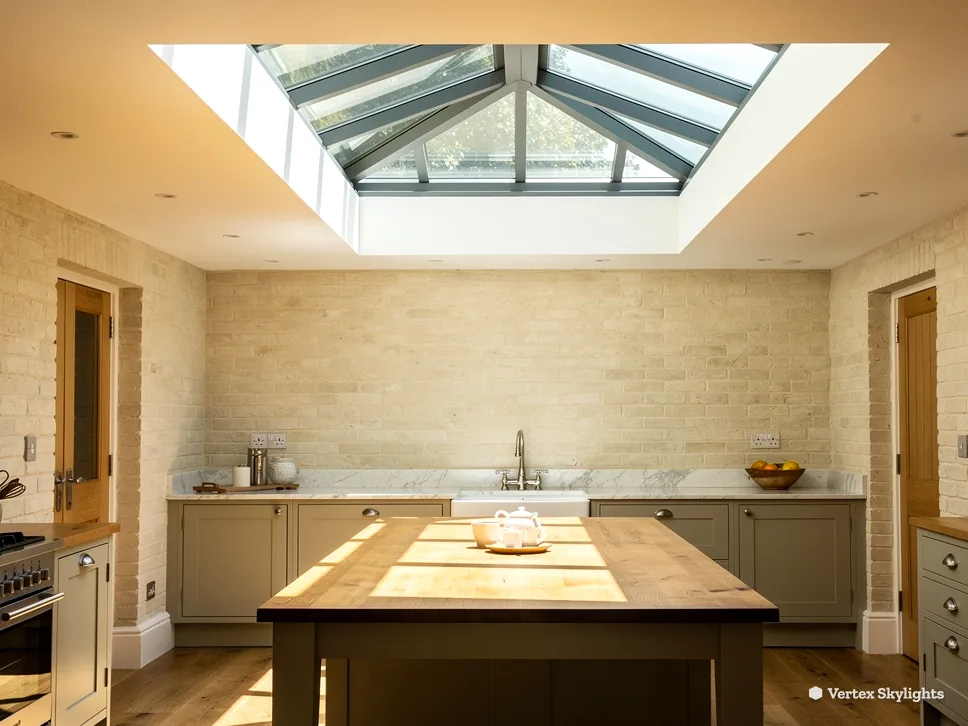
Over the table or island, in the part of the room the garden doors cannot reach. The lantern lifts the ceiling and puts the sky above the worktop.
-
Garden rooms and studios
A small room reads larger once the ceiling opens into glass. One lantern can light the whole space from the centre.
-
The link between old house and new
Where an extension meets the original walls, the join can be a dim corridor. A narrow lantern over the link brings daylight to the back door and the hall.

Built to last
- We survey before we price
- Your written quote does not change on the day
- Building Control notification handled
- 10 years on our workmanship, in writing
Roof lanterns, start to finish
Putting a roof lantern on a Milton Keynes extension, and getting it right
A lantern is a small glass house on top of a flat roof. It solves one problem very well, and it asks for care at the edges. Here is the whole job, from the first measurement to the plastered reveal.
The middle of the extension is dark
The doors light the garden end. The rest of the room waits for a lamp.
Sideways
Daylight from doors and windows travels sideways. It brightens the strip of floor nearest the glass and thins out as it crosses the room, so a deep rear extension ends up with a bright garden end and a dim middle. The table, the island and the sofa, the places you actually spend your day, sit in that dim middle.
Side windows also look at things: a fence, a boundary wall, a neighbour's gable, a tree. The light they let in has already been trimmed by whatever stands outside.
Wider doors only move the bright strip. They cannot push daylight several metres into the back of a room.
Straight up
A roof lantern puts glass directly over the middle of the room. Its pitched panes face the open sky, and straight up is clear: nothing stands between a lantern and the sky the way a fence stands between a window and the garden. Daylight arrives from above and lands where you sit.
The raised frame adds something a flat rooflight cannot. The ceiling climbs into the glass, and the eye follows it. A modest lantern changes how a flat-roofed extension feels, because the room no longer stops at a plasterboard lid.
If you already know the room has a poor middle, the lantern is the product built to fix that one thing.
The size of the lantern follows the room, not the other way round. At the free survey we measure the opening and the roof around it, then set the lantern's dimensions so there is enough flat roof left for a proper upstand and for water to drain. A lantern that is too big for its roof is a leak waiting to happen; one that is too small leaves the middle dim. Our roof lantern size guide walks through the sums.
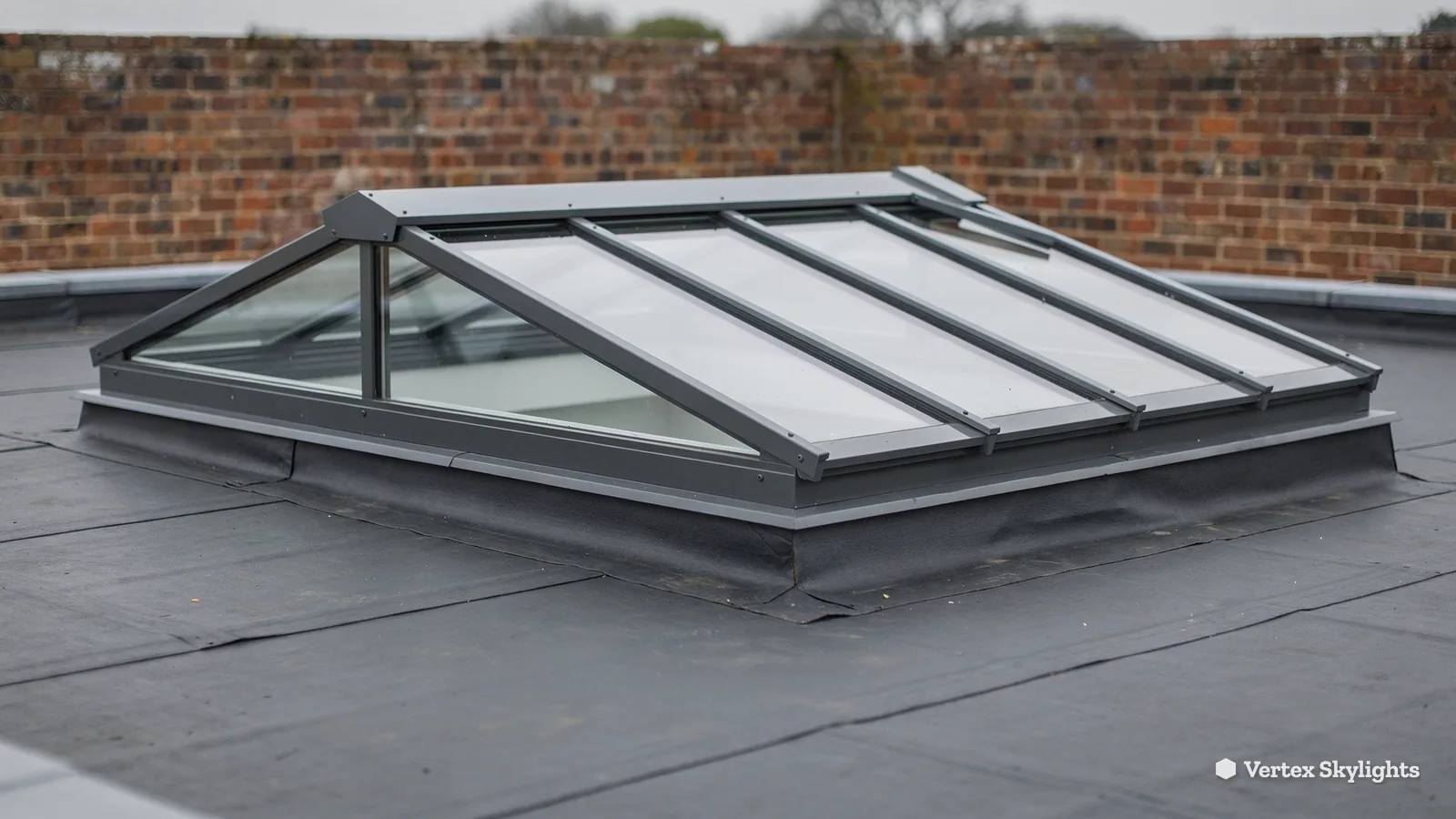
Lanterns are made to measure in powder-coated aluminium frames. Aluminium holds slim glazing bars, so the glass stays the main thing you see, and the finish does not need painting. A roof lantern is a skylight in the homeowner's word and a rooflight in the trade's; the two mean the same thing, and you will hear either from us.
Plenty of people ask whether a lantern is the same as the glass roof of an old conservatory. It is not. A modern lantern is a factory-built, thermally broken frame with sealed units, sitting on an insulated kerb. It is closer to a piece of roof than a piece of greenhouse. If your extension is an orangery style room with a brick pier and a flat roof, a lantern is exactly the glazing that style was designed around.
When a flat rooflight is the better answer, we say so. A wide, low room with a small footprint can be lit very well by a flat pane, and it costs less to build around. The two are set side by side in our roof lantern or flat rooflight comparison, and the flat roof rooflights page covers the other option in full.
Glass overhead can run hot and glare
A sunny afternoon under the wrong glazing is not a pleasant place to sit.
Sideways
Glass roofs have a reputation, and some of it was earned. Older conservatory roofs used basic glazing that let in a great deal of solar heat in summer and lost warmth quickly in winter. The room underneath swung from stifling to chilly, and the blinds stayed shut.
Glare is the other complaint. Bright sky straight overhead, with nothing to soften it, can make a kitchen worktop hard to look at on a clear afternoon.
Then there is the question of fresh air. A room with a flat ceiling and no way for warm air to rise leaves the heat where you are.
Straight up
A modern lantern uses sealed double glazing, or triple glazing, with a low-emissivity coating on the glass. The outer pane can also carry a solar-control coating or a light tint, which cuts the heat gain while keeping the daylight. The sealed units hold warmth in on a cold evening, so the room settles instead of swinging.
For ventilation, a lantern can carry an opening vent at the highest point of the ceiling, where warm air collects. Electric vents work from a remote or a wall switch, and a rain sensor closes them when a shower starts. Our page on electric opening rooflights explains how they work.
Which build-up suits you depends on which way the roof faces and how the room is used. We talk it through at the survey.
Lantern words you will hear
Upstand
The insulated kerb the lantern sits on, lifting it clear of the flat roof so water runs away.
Ridge
The top bar where the two sloping sides of the glass meet, running along the length of the lantern.
Glazing bar
The slim aluminium section that holds one pane to the next, running down the slope of the glass.
Solar-control glass
Glass with a coating that turns away part of the sun's heat while letting daylight through.
Thermal break
A strip of insulating material inside the aluminium frame that stops warmth crossing from inside to out.
Flashing
The sheet or membrane that seals the junction between the lantern's kerb and the roof covering.
Glare and heat are handled together, and blinds are part of the answer. Roof blinds sit under the lantern, either fixed to the frame or on tracks, and can be manual or powered. Some owners want them on from day one, and others add them after a summer. The frame can be specified to take them, so the choice stays open. A blind is the easy way to soften direct sun at a particular hour, and the glass does the long-term work.
Ask about the colour of the frame too. Inside and outside can be different, so a dark grey exterior can sit over a white interior that matches the ceiling. The choice changes how heavy the lantern looks from the garden, and how quietly it blends with the plaster indoors.
Think about security as well, since a lantern is a glazed opening in the roof. Laminated inner panes hold together if they are struck, and multi-point locks on opening vents keep a vent shut against a hand from outside. Ask for these at the survey if they matter to you.
A lantern is not a window to look out of, and that is part of its calm. It does not frame a fence or a bin store. The view is cloud, branches at the edge, a bird crossing, the colour of the sky changing through the afternoon. Because straight up is clear, you get the sky at its widest without the clutter of the ground.
The same sums run the other way in winter. A lantern in a well-insulated extension adds daylight when the sun is low, and the heating does less of the work of lifting a gloomy room. Our energy efficient rooflights page covers how the glass choice changes the heat balance, and the double or triple glazed rooflights answer takes the choice step by step.
Cutting into the roof needs a structural check
The glass is the visible part. The frame around the hole does the real work.
Sideways
Anyone asking whether you can add a roof lantern to an existing roof is asking about the structure first. A flat roof carries a load of joists, decking, insulation and a waterproof covering. Cut through it and you take out some of what holds it up.
A lantern also brings its own weight. The frame and the sealed glass are heavy compared with the roof they replace, and that weight needs somewhere to go.
Get either wrong and the roof sags around the opening, the upstand loses its fall and water pools against the glass.
Straight up
The opening is framed before the lantern arrives. Trimmer joists around the hole pick up the cut joists, and the upstand sits on that frame, so the lantern's weight passes into the structure and not onto the decking. Where the span or the load asks for it, a structural engineer's calculation settles the sizes before work starts.
The upstand is built on a fall and insulated, then covered with the same waterproof membrane as the rest of the roof. The membrane is dressed up the outside face and sealed under the lantern's flashing, so the junction between lantern and roof is a lapped, weatherproof joint rather than a line of sealant.
Fitted properly, a lantern on a flat roof is as watertight as the roof around it.
| Option | Suits | Best at | Know |
|---|---|---|---|
| Roof lantern | Flat roof, deeper room | Height and light from overhead | Needs room for an upstand all round |
| Flat rooflight | Flat roof, shallow or narrow room | Clean line, low profile | Stands on an upstand, the glass given a slight fall |
| Roof window | Pitched roof, loft rooms | Light plus a view of the sky | Needs a pitch to sit in |
| Sun tunnel | Small dark spaces | Landings, hallways and bathrooms | Lights a patch, not a whole room |
We look at the existing roof at the survey before anything is priced. What is the covering? Is there already an upstand or an old rooflight to replace? Where do the joists run? Can the opening be placed without cutting more than it must? Those answers decide the order of work, and they are the reason the quote is fixed and written down. Nothing is guessed on the day.
The best-placed lantern is usually not in the exact middle of the roof but over the part of the room that needs the light. We place it by what you do under it: over the dining table, over the island, over the sofa. The measurement from the garden doors to the back wall matters, and so does where the sun falls at different hours.
The same question comes up for old houses and new ones, and the answer is the same: check the structure, frame the opening, build the upstand to a fall and seal the flashing. If you are comparing options for a roof that is not flat, our page on whether a skylight can go in any roof covers pitched cases.
Replacing an old lantern, or an ageing glass roof from an earlier extension, follows the same logic with one extra step. The old unit comes out, the upstand is inspected, and anything that has settled or softened is rebuilt before the new frame goes on. A fresh lantern on a tired kerb only moves the problem, so the kerb gets the same attention as the glass.
A lantern is not the only glass you can put in a flat roof. The table above shows where each one fits, so you can see whether the lantern is the right product for the room before we talk about anything else.
Lanterns come from several makers, and the brands differ in the slimness of the bars, the glass on offer and the finish of the frame. We choose the range that suits your opening and name it in the quote. Where the extension has a pitched roof of its own, a VELUX window in that slope can bring light into the same room.
A cold edge can mean condensation
Droplets on the glass or a damp stain on the reveal mean warmth is escaping somewhere.
Sideways
Glass is always the coldest surface in a room. Warm, damp air meets it and turns to water. A poorly made frame makes this worse, because the aluminium conducts cold straight through to the inside, and a badly insulated upstand leaves a cold strip around the whole opening.
The signs are droplets on the underside of the glass, a damp line on the plaster, and in time a black mark where mould has settled. A misted unit, with a haze trapped between the panes, is a different fault: the seal has failed and moisture has got in.
Straight up
Part L of the Building Regulations sets the limits. For rooflights in existing homes, Approved Document L, Table 4.2, gives 2.2 W/m²K. A good lantern beats that comfortably, with a thermally broken frame, a warm-edge spacer in the sealed unit and argon between the panes. That keeps the inner pane warm, and a warm pane does not mist.
The upstand is insulated all the way up, and the inside reveal is finished with the plaster or lining taken right to the frame, so there is no cold gap. Energy efficiency comes from the whole build, not the glass alone.
The regulation figures that apply
- 2.2 W/m²K
- Part L cap on rooflights in existing homes (Approved Document L, Table 4.2)
- 1.4 W/m²K
- Part L cap on roof windows in the same table, or WER band B
A lantern in the roof of a kitchen or bathroom is in the wettest room in the house, so insulation and ventilation work as a pair. Extractor fans, an opening vent and a warm inner pane stop the moisture lingering. Our misted rooflights hub explains what happens when a sealed unit lets go, and the page on why rooflights mist up sorts the causes.
Look after the glass and it will look after you. Wash the outside with water and a soft brush, and wipe the inside as part of ordinary cleaning. Check that the weep holes and gutters in the frame are clear of leaves and moss, especially if a tree overhangs the roof. Over time, powder coatings can fade a little, and sealed units are the part to watch. The glass should stay clear, not discoloured, brittle or crazed, and a pane that has gone cloudy is a pane to replace. Routine aftercare and maintenance come down to a wash, clear weep holes and a look at the seals after a storm; if anything looks wrong, send us a photo. We install and replace lantern glass and whole lanterns, and the guarantee covers our workmanship.
There is also a rule to know about. England's Building Regulations set no daylight minimum for houses, so nobody will tell you how much glass you must have. The sizing is yours to decide with us, and the regulation that does bite is the thermal one, which is where the figures above come in.
The mess and the unfinished edges
A roof lantern job should end with a finished ceiling, not a list of other trades to call.
Sideways
Putting glass in a roof sounds like a day's work, and the roofing part can be. What makes a job drag is everything around it. Who plasters the reveal? Who makes good the ceiling? Who tells the council? The homeowner ends up chasing four trades for four small tasks.
Uncertainty is its own cost. Without a clear plan, a roof can stay open to the weather for longer than anyone is comfortable with, and a room can sit under dust sheets for a week.
Straight up
One firm carries the work from the survey to the finished reveal. Fitting is quick on site: a typical rooflight is in place within a day or two, and a lantern on a prepared upstand keeps to the same pace: the opening is made safe and weathered the same day, the lantern is lifted and fixed, and the flashing is dressed. The plan for the day comes with your written quote.
Finishing the inside is part of the job: lining or plaster is taken up to the frame and left clean. For anything notifiable, we handle the Building Control notification, so the installation is on the record and built to the standard in force.
Before you book a roof lantern
- Is the lantern placed over the part of the room you actually use?
- Who frames the opening, builds the upstand and seals the flashing?
- Is the inside finish, the plaster or lining, part of the quote?
- Who handles the Building Control notification, where it is needed?
- Is the guarantee in writing, and what does it cover?
This is the order of a typical lantern job, from first call to finished room.
- Free survey. We visit, measure the opening and the roof, check the structure and talk through glass, vents and blinds.
- Fixed written quote. You get a quote that does not change on the day, with the work set out step by step.
- Preparation. The lantern is made to measure and the date is agreed. We protect floors and furniture before anything is cut.
- Opening and upstand. The roof is opened, the trimmers fitted, the upstand built to a fall and insulated.
- Lantern and flashings. The lantern is lifted into place, fixed and weathered with the membrane and flashings.
- Finishing inside. The reveal is lined or plastered, the room is cleaned and we show you how the vents and blinds work.
For a clearer picture of timings, read our answer on fitting times for a skylight. The fitting is the short part of the job, and the survey and the made-to-measure lead time come before it.
The installation process is built so that you can stay in the house. Dust is the biggest nuisance, so we confine it, and the plastering is part of our work, not an afterthought. If you want to see how a lantern finishes at the edge, raise it when we visit and the build-up will be drawn out for you.
Keep your paperwork from the day. The written quote, the guarantee and the Building Control record belong together, and they matter if you sell the house or add to it later. To book the survey, send one photo showing the room and a second showing the roof to info@vertexskylightsmiltonkeynes.co.uk or WhatsApp 07880 284133.
The checklist above is worth putting to any installer before you book, including us.
Planning, cost and whether it is worth it
Three questions come before any order. Is it allowed, what moves the price, and is it worth it?
Sideways
A lantern is a visible change to a roof, and it is a larger purchase than a plain window. So the questions come in a fixed order. Can I do this without planning permission? What will it cost? And is it really better than the simpler option?
The honest answers depend on the house, the roof and the way you live, and a page cannot settle them from a distance. What it can do is say where to look and what the answers turn on.
The trap is deciding on price alone. A lantern that is cheap to buy and wrong for the room is the dearest one in the end.
Straight up
Planning first. A roof lantern on an extension can fall within permitted development, but flats, listed buildings and homes covered by an Article 4 direction are different. Inside a conservation area those rights remain, and it is an Article 4 direction that can remove them. Our Milton Keynes planning guide explains how to check, and our planning answer for roof lanterns goes through the steps. Milton Keynes City Council's planning team can confirm your position, and we can tell you what to ask.
Cost next. Size, glass specification, vent type, blinds, the state of the existing roof, access for lifting and the amount of finishing inside all move the price. We do not print numbers on a page, because the house sets them. The free survey produces a fixed written quote that does not change on the day. Our roof lantern cost guide explains each factor, and the costs page sets out how we quote.
Verdict: for a deep flat-roofed room with a dim middle, a roof lantern on a properly built, insulated upstand gives the best light and the most ceiling height; for a shallow room, a flat rooflight may be all it needs.
Then the question people ask us most directly: are roof lanterns worth it? The straight answer is that it depends on the room. In a deep extension with a dim middle, a lantern changes how the whole space feels. In a bright, shallow room that already has good light, it may add little and a flat rooflight, or nothing, may serve you better. We would rather tell you that at the survey than build something you do not need.
You can also weigh a lantern against a walk-on pane in a roof terrace or garden room floor, which is a different product with a different job. Our walk-on rooflights page covers it.
Areas covered for roof lanterns
We work across Milton Keynes and the towns and villages within about thirty miles of it. See the areas we cover to check yours. Wherever you are in the radius, the survey is free and the quote is fixed.
The written guarantee behind the work
The guarantee is in writing: ten years on our workmanship, set out in the paperwork you keep. Read the guarantee page for the wording. Everything we fit meets the Building Regulations in force on the day, the inside is finished and the site is left tidy.
The best way to judge a lantern is to look at it in a room like yours. In an installed lantern, look at the upstand, the frame and the finished ceiling. Look at how slim the bars are, how the lantern meets the roof, how the plaster meets the frame. Those details separate a good job from a hurried one, and they are worth a slow look before you sign anything. When you have looked, book a free survey or message us on WhatsApp.
Start with the sky. It is the one view nothing blocks, and a roof lantern is the way of bringing a room under it. Read more about the idea on our straight up is clear page.
Roof lantern questions, answered
Can you add a roof lantern to an existing flat roof?
Yes, where the structure allows it. We check the joists, frame the opening with trimmers, build an insulated upstand to a fall and seal the flashing into the existing covering. A free survey comes first, and our size guide shows how the opening is chosen.
How much does it cost to install a roof lantern?
Size, glass, vents, blinds, the condition of the roof and the finishing inside each move the figure. We settle all of them at the survey and write one fixed quote that holds on the day. Our roof lantern cost guide explains what moves the price.
Is planning permission needed for a roof lantern?
Whether a lantern needs permission turns on the type of house and the conditions that apply, and flats, listed buildings and Article 4 areas follow different rules. Start with our planning guide and the roof lantern planning answer.
Will a roof lantern make the room too hot?
Not with the right glass. Solar-control coatings, a tinted outer pane, an opening vent and roof blinds all keep a south-facing lantern comfortable. We choose the build-up for the way your roof faces and the way the room is used.
Free survey
Book your free survey
No obligation. We survey before we price.
Or WhatsApp 07880 284133