Misted Rooflights in Milton Keynes
A rooflight that has gone cloudy between the panes has lost the seal that kept its glass clear. We fit a new sealed unit, or replace the whole rooflight when the frame has had its day, and leave the ceiling tidy.
Where we replace misted glass
Any rooflight with a sealed double glazed unit can mist. These are the places the clouding is hardest to live with.
-
Kitchens under a flat roof
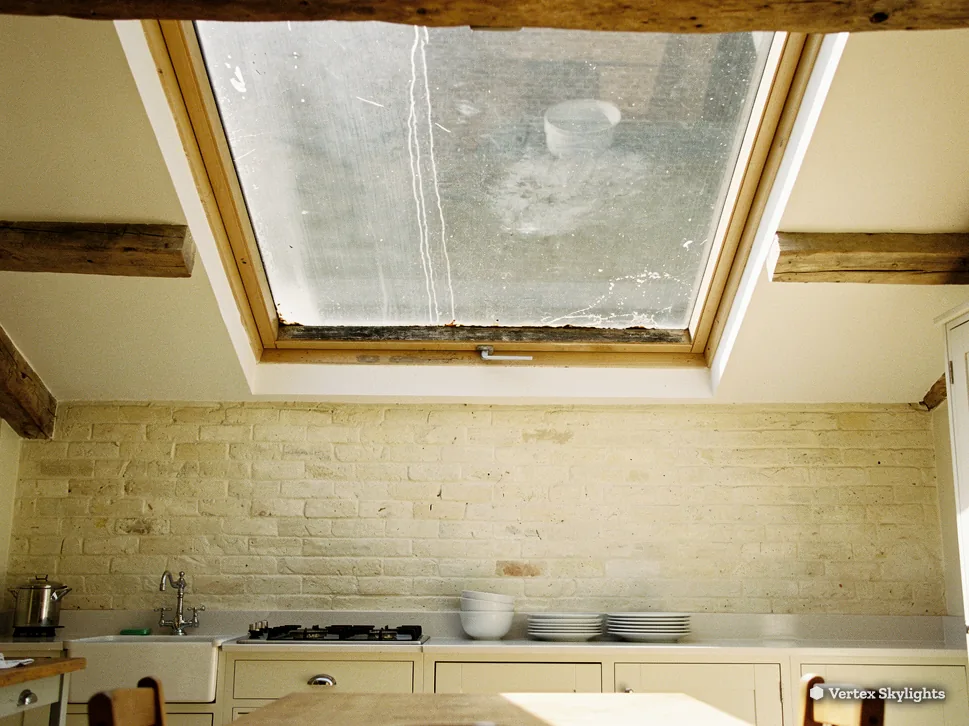
A fogged rooflight over the worktop turns bright daylight into a grey wash just where you chop, cook and read the post.
-
Loft rooms and bedrooms
A clouded roof window above a bed hides the sky and the stars, and it can make a small loft room feel closed in.
-
Landings and hallways
A stairwell that relies on one rooflight for its daylight shows the haze at once, and the whole house feels dimmer.

Built to last
- We survey before we price
- Your written quote does not change on the day
- Building Control notification handled
- 10 years on our workmanship, in writing
Misted rooflights, start to finish
Putting clear glass back in a misted Milton Keynes rooflight
A skylight that has fogged between the panes is telling you its seal has gone. Here is what that means, what can be replaced, and how a clear sky comes back.
The glass has clouded over
You can wipe the inside and the outside. The haze stays, because it is trapped between.
Sideways
A misted rooflight shows a milky film, a drift of tiny droplets, or a pale patch that grows and shrinks with the weather. You clean both faces of the glass and nothing changes. The mist lives in the gap between the two panes, where a cloth cannot reach.
It is more than a cosmetic fault. A clouded rooflight scatters the sky instead of passing it on, so the kitchen, loft room or landing below gets a flat, grey light even on a bright day. Windows in the side walls still look at fences, walls and neighbours. The one view that nothing blocks is the sky overhead, and a misted unit is hiding it.
Straight up
A modern rooflight is built around a sealed unit: two or three panes of glass held apart by a spacer bar, bonded at the edges, with dry air or gas in the gap. Mist means that seal has let go. The cure is glass replacement: a new sealed unit, made to measure for the existing frame, in place of the failed one.
When the unit goes in, the sky returns. Natural light comes through clear glass straight from above, and the room loses that overcast look. Our guide to why rooflights mist up explains how the seal fails, and our answer on replacing misted glass gives the short version.
People use several words for the same fault. A blown unit, a failed seal, a fogged pane, a misted skylight and condensation between the panes all describe one thing: moisture inside a sealed unit that was meant to stay dry. You may also hear it called a blown double glazed unit, because the unit has stopped doing its job as a sealed pair.
The first step is always the same. We visit, look at the rooflight from inside and out, measure the glass and the frame, and tell you plainly which parts need replacing. The survey costs nothing, and the written quote that follows is a fixed one.
Why clear glass brings natural light and wellbeing back
Why bother, when the rooflight still lets some light through? Because the quality of the light changes the room. Clear glass overhead gives daylight that is even, bright and free of shadows from the neighbours, and that lifts the mood of a kitchen or a bedroom in a way a lamp cannot. We all feel the difference between a sky-lit room and a room lit from the side. A misted unit takes that away without anyone noticing the day it happened, because the haze creeps in a little at a time.
Clear glass is also a matter of view. Lying in a loft bedroom and watching cloud, rain or a bird cross the glass is one of the quiet pleasures of a rooflight. A clouded unit turns that into a pale blur.
Think about what you lose when it goes unfixed for another winter. The room is darker, so the lights go on earlier. The ceiling lining takes up whatever moisture the failed unit lets through. The glass can start to look stained, and the stain does not lift. Putting it right is better done sooner than later, and it is a job we plan around your week.
Is it mist or is it condensation?
Water on a pane is not always a failed seal. Where the water sits tells you.
Sideways
Rooflights collect water on their surfaces for ordinary reasons. Warm, damp air from a kitchen, a shower or a drying rack meets cold glass and leaves a film of condensation on the inside face. On a clear cold night the outside face can mist over too, as dew. Both come and go with the weather, and both wipe away.
That makes it hard to know what you are looking at. Someone sees a wet pane on a winter morning and fears the worst. Someone else sees a permanent cloud between the panes and puts it down to damp.
Straight up
Run the cloth test. Wipe the inner face and then, if you can reach it safely, the outer face. If the wetness comes off, it was surface condensation, and the cure is better ventilation in the room, a rooflight with a trickle vent, or a warmer inner pane. If the cloud stays put and sits between the panes, the seal has failed.
Our answer on condensation inside or between the panes walks through the test with the weather in mind. If you are not sure, we look at it on the survey and say which it is.
Words you will hear
Sealed unit
Two or three panes of glass bonded to a spacer bar so the gap between them stays dry and clear.
Blown unit
A sealed unit whose edge seal has failed, letting damp air in and leaving mist between the panes.
Spacer bar
The slim strip around the edge of the unit that holds the panes apart and carries the drying agent.
Desiccant
The drying granules inside the spacer that absorb stray moisture until they can hold no more.
Low-E coating
A thin invisible layer on one pane that keeps heat in the room without dulling the glass.
Upstand
The raised kerb a flat roof rooflight sits on, so rain runs away from the frame.
Surface condensation is worth taking seriously even though the glass is sound. Damp air that keeps meeting a cold rooflight can darken the plaster in the lining, lift paint and encourage mould on the reveal. The usual cause is a cold edge, a missing insulated lining, or a room with too little ventilation. An electric opening rooflight with a remote control and a rain sensor clears the air from the top of the room without you thinking about it. See our page on electric opening rooflights if that sounds useful.
A real fault, by contrast, only gets worse. The cloud between the panes spreads, and a pale crust or a line of dried marks can settle on the inside of the glass where the moisture has dried and returned again and again.
There is a simple habit that helps. Look at the rooflight at the same time of day in different weather. A surface film shifts with the temperature and the humidity in the room. A failed seal does not shift in step with them: the cloud may thin in dry weather and thicken in damp, but it never clears completely, and it never comes off with a cloth. If you take a photograph on a bright morning and again on a damp one, you will see which kind you have.
If you have a pitched roof window you can reach safely from inside, open it and look at the inner pane's edge. A pale tidemark that sits inside the glass line is a sign of a unit that has dried and wetted repeatedly.
It helps to know what feeds condensation in a home. Cooking, bathing, drying washing indoors and even a crowded room put water into the air. A rooflight is the coldest surface in the room, so it collects that water first. A kitchen rooflight with a cooker hood that vents outside will stay clearer than one in a kitchen with no extraction. In a loft bedroom, a trickle vent or an opening roof window lets the night's breath out. These small things protect a new unit as well as an old one.
The glass is failed but the frame is not
A new unit is not always the answer. The frame that holds it has to be in a fit state.
Sideways
The glass is the part you can see, so it is easy to assume it is the only part that has aged. A misted rooflight can sit in a frame that is perfectly sound. It can equally sit in a frame that has begun to let go: seals that have hardened, a timber kerb with soft patches, flashings that have lifted, a lining stained by years of slow seepage.
Putting new glass into a tired frame is a poor bargain. The new unit sits in the same weak spot, and the fault returns.
Straight up
So we look at both. If the frame, kerb and flashing are sound, we replace the sealed unit alone. The new unit is made to measure to the existing opening, glazed in and sealed so the rooflight is weatherproof and watertight again. That is the lighter job and the one that suits a frame in good order.
If the frame has discolouration, brittle or cracking plastic, rot in the kerb or flashing that has had its day, we replace the whole rooflight. That is the moment to reconsider the size, the glass and the opening method, because the work is already open. Our guide on replacing a misted rooflight, unit or whole rooflight sets the two routes side by side.
| Route | Choose it when | What changes | Know |
|---|---|---|---|
| New sealed unit only | Frame, kerb and flashing are sound | The glass alone | Lightest job, finished inside |
| Whole rooflight, same size | The frame is tired or cracking | Glass, frame and seals | Opening and finish stay |
| Whole rooflight, new size | You want more light overhead | Opening, trimming, finish | Measured at the survey |
| Different type of rooflight | The room has changed use | Style and opening method | We explain the options |
On a flat roof a rooflight sits on an upstand with the glass at a slight fall, and the upstand has its own insulation and covering. If that build-up is wet or worn, we say so before we quote. A roof window on a pitched roof sits between the rafters with flashings that lap the roof covering. If the opening needs the rafters trimmed to take a different size, we price that into the fixed quote at the survey, not on the day.
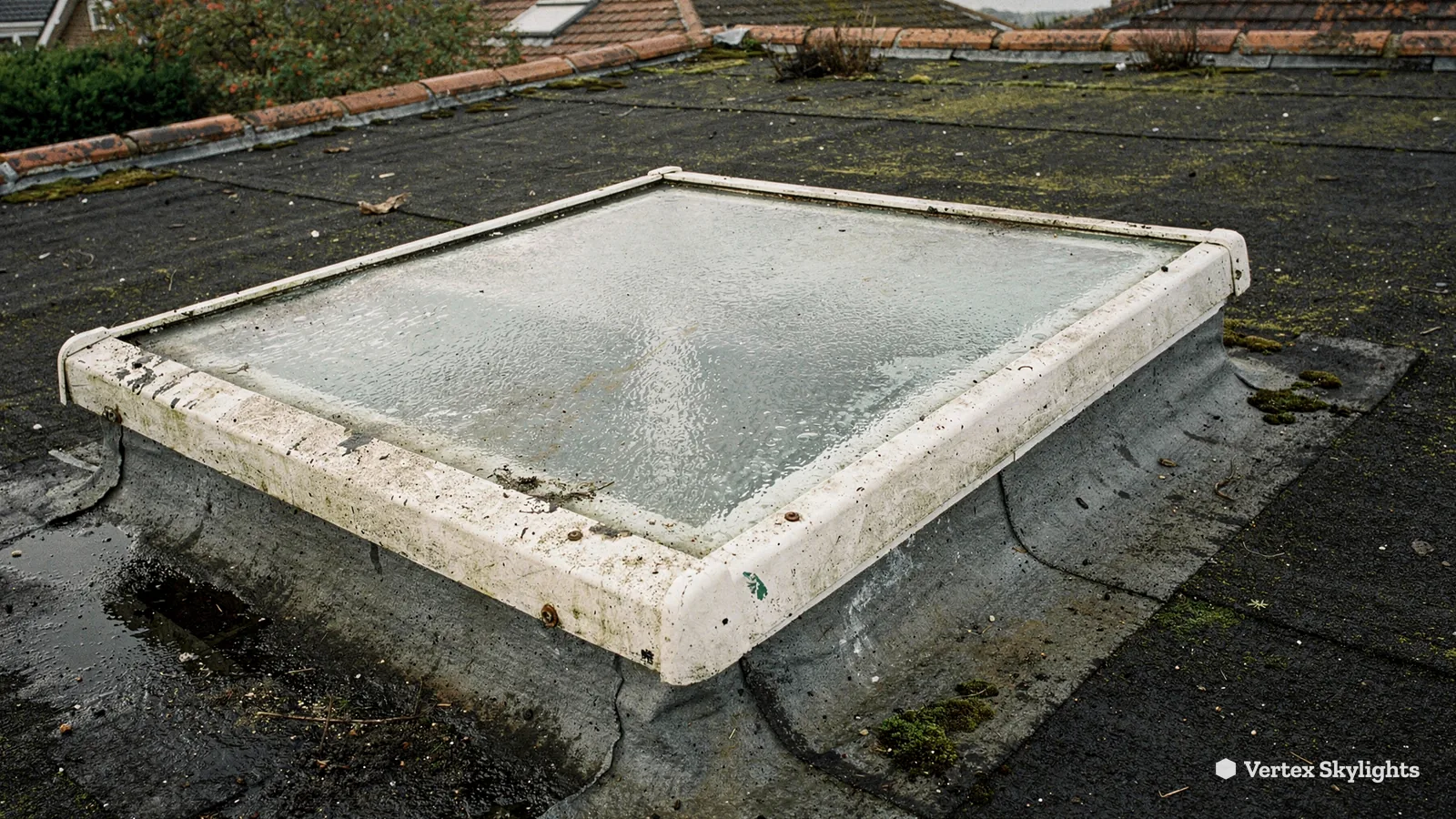
The frame material matters too. Older rooflights may carry clouded or yellowed acrylic domes, polycarbonate or GRP curbs, or timber frames; newer ones use powder-coated aluminium frames, which stay straight and do not need painting. A dome rooflight, a pyramid or a flat glass rooflight can each take a new double glazed unit in a suitable frame, and we tell you which of those you have.
The installation process, step by step
The installation process for a whole rooflight follows a clear order. We protect the room below and the floor. We take out the old glass and frame, check the roof structure and trim the opening if it needs it, and prepare the kerb or the rafters. We fit the new frame, seal it, weave in the flashing so rain runs over it and not under it, and glaze it. Then we finish inside: the lining, the plaster, the paint-ready edge. A unit-only job follows a shorter version of the same route.
On a flat roof the upstand is checked for insulation and for the fall of the roof covering. On a pitched roof the flashing kit has to suit both the roof covering and the rooflight. A mismatch is where leaks begin, so we plan it at the survey and not on the day.
Think, too, about the roof covering around the rooflight. Slates, tiles or a membrane roof each need a flashing detail that suits them, and a flashing that has hardened or lifted is a route for water that the new glass cannot fix. If the covering is tired, we point it out at the survey so you can decide what to do about it before the new rooflight goes in. Water-tightness is a property of the whole assembly, not of the glass alone.
You cannot tell what to replace from the floor
A misted rooflight is a few metres overhead. Judging it from below tells you little.
Sideways
From inside you see a hazy patch and a ceiling lining. From outside, if it is a flat roof, you might see a dome with a tidemark. Neither view tells you the make, the size, the glass build-up or the state of what holds it. Pitched roof windows add a code and a handing, and you may not know which of the manufacturer's ranges you have.
Guessing leads to the wrong glass ordered and a second visit, and a sealed unit ordered to the wrong size cannot be used at all.
Straight up
We survey it properly. We check the rooflight from inside and out, measure the existing dimensions to the millimetre, note the glass specification, look at the frame, kerb and flashings, and check the opening mechanism, the blinds if there are any, and any wiring for electric operation. Then we explain what we found and what we recommend.
If you have a branded rooflight, say a VELUX roof window, the make and size code help us find the right unit or the right replacement from the manufacturer range. Our guide to VELUX windows explains the size code, and our roof windows page covers how a pitched roof window is built.
Before the survey
- Where is the mist: on a surface you can wipe, or between the panes?
- Do you know the make and the size code on the frame, if there is one?
- Is the rooflight on a flat roof or between pitched rafters?
- Are there blinds, a remote or a rain sensor to keep working?
- Which room sits below, and how is it used?
The survey is free. After it you receive a fixed written quote that does not change on the day, with the work spelled out: the glass, the frame if it changes, the flashing, the finishing inside and what happens to the old unit. Bespoke units take time to make, and a clear quote means no surprises when they arrive.
Fitting itself is usually one or two days. We protect the floor, set up the access and keep the room usable. When the new unit is in, the inside is finished: the lining, the plaster or the trim round the opening. We do not leave a rough edge for you to chase.
Glass and materials are worth a little time. The panes in a sealed unit can be clear, toughened, laminated, tinted, self-cleaning or coated for solar control, and which you pick depends on the room below, the roof angle and the way the sun reaches it. Laminated glass stays in one piece when struck, which is why it is used where people sit or walk beneath. Toughened glass is stronger against knocks and temperature swings. Frames in aluminium stay straight and need no painting, and timber and PVC frames have their own care needs.
If the old rooflight used polycarbonate or acrylic glazing, you may be able to swap it for glass for a clearer, better insulated finish. We discuss that at the survey, because the frame has to carry the weight of the glass.
When the day arrives, you will find us tidy. We lay out dust sheets, keep the work area small and sweep up as we go. The old unit leaves with us. The room is yours again by the evening of the last day, with the opening finished and the light coming straight down through glass that is clear.
The internal finishing comes with the replacement. Where the rooflight sits in a lining or a light well, the plastering round the opening is made good, the corners are squared and the surface is left ready to paint. A glass-only job leaves the lining as it is, while a whole new rooflight means the internal finishing is redone to match the new opening.
A cold rooflight wastes the heat you pay for
A failed unit is also a chance to put a better one in.
Sideways
A sealed unit that has lost its seal has also lost much of its insulation. The dry gas or air between the panes was part of what kept the glass from being a cold plate. Once damp air is in, the rooflight stops pulling its weight, and the room beneath it feels the draught of cold coming down.
In a bathroom or a kitchen the cold glass also catches steam. The result is condensation on the inside of the lining, damp stains on the ceiling and mould where the plaster meets the frame.
Straight up
A new sealed unit changes that. Modern double glazing uses a low-emissivity coating, a warm-edge spacer and a sealed gap that holds its dry air or gas. The glass keeps the warmth in, and the lining stays dry. For better energy efficiency we can fit a U-value that beats the legal limit; our energy efficient rooflights page shows the options.
A well-built unit also controls glare and heat gain. A solar-control coating or a light tint on the outer pane softens a south-facing rooflight, and blinds fitted to the frame take the rest of the sun off the room.
The regulation figures that apply
- 1.4 W/m²K
- roof window limit, Part L Table 4.2, or WER band B
- 2.2 W/m²K
- rooflight limit, Part L Table 4.2, existing dwellings
The regulations set the baseline. The figures above come from Approved Document L, Table 4.2, which covers work to existing homes. Replacing a rooflight or its glazing is work that falls under the Building Regulations, and we install to current standards. For notifiable work we make the Building Control notification ourselves, so you do not have to chase it.
Planning is a separate question. Replacing a rooflight like for like rarely changes how a house looks from the street, but some homes sit under extra controls. Our planning guide explains where to start, and your council's planning team will confirm the position for your street.
Blinds and controls deserve a thought while the rooflight is out. A blind is much easier to fit with new glass and a new frame than later. A blackout blind helps a bedroom under a south-facing roof, a pleated blind softens a kitchen, and a roller blind with a solar-reflective face cuts the heat on a summer afternoon. Remote and rain-sensing controls can be wired or solar powered, and we explain the options so you can pick without a surprise afterwards.
Fresh air matters too. A rooflight that opens lets warm, stale air out at the high point of the room, which is a simple form of ventilation that works without a fan. If you have a fixed rooflight now and want one that opens, a replacement is the moment to change it.
Aftercare for a new unit is light. Wipe the glass with a soft cloth and mild soap, keep the drainage slots and trickle vents clear, and look over the seals and the finish round the frame from time to time. That routine maintenance keeps the glass clear, and the 10-year workmanship guarantee in writing sits behind what we fitted. If anything looks wrong, message us on WhatsApp.
The rooflight is old and the brand is gone
Not every misted skylight is one you can order a unit for off the shelf.
Sideways
Some misted rooflights are barely a decade old. Others are older than the extension they sit on, fitted by a previous owner with no paperwork and no maker's mark. The frame may carry a faint label, or none at all, and the glass is a mystery. The company that made it may no longer trade.
That does not stop the work, but it means a unit has to be made to the exact size and build-up of what is already there, not picked from a catalogue.
Straight up
We measure the opening and the glass edge to edge and order a bespoke unit that fits, sealed to the frame, with the right thickness of glass for the rebate. If the frame is sound, the old rooflight carries on with fresh glass. If it is not, we propose a whole new rooflight, with a new flat roof kerb or new pitched roof flashings as the roof requires.
For a house with a conservation area setting, a slim, flat-fitting rooflight sits quietly in the roof. Our page on conservation rooflights explains that choice, and our flat roof rooflights page covers the flat roof side.
Verdict: for a rooflight with a sound frame, a new made-to-measure sealed unit brings the sky back at the lightest cost in disruption; for a tired frame, replacing the whole rooflight is the better answer.
Areas we cover around Milton Keynes
We work on residential properties first, in kitchens, lofts, bedrooms, landings and extensions. We also take on small commercial jobs, such as shops, offices and workshops, where a bank of rooflights has clouded together and the room below has lost its daylight. The approach is the same: survey, fixed quote, replacement and finish.
We cover Milton Keynes and the towns around it. If you are unsure whether we reach your address, WhatsApp us on 07880 284133 or send an email to info@vertexskylightsmiltonkeynes.co.uk, and we will tell you.
Every job carries a 10-year workmanship guarantee in writing. Keep it with the quote, and keep the details of the new unit; they help if you ever need to talk to us about it. Look after the rooflight too: keep the vents clear, wipe the glass and clear leaves from the upstand so water runs off the way it should.
A few closing thoughts. A misted rooflight is a fault that can wait a while, but it will not mend itself, and the longer the seal is open, the more damp the lining takes in. Replacing it is a contained piece of work: measure, make, fit, finish. You get a clear sky, a warmer room and a rooflight that looks as it did the day it went in.
For the whole picture, read our guides, then book the free survey and let us look at it with you. Our WhatsApp number is 07880 284133 and our inbox is info@vertexskylightsmiltonkeynes.co.uk. Look at our guarantee and our page on costs first if you prefer to read before you call, and see why straight up is clear for the idea behind everything we fit.
Misted glass, answered plainly
Can the mist be removed from the glass?
Not from between the panes. The moisture is sealed inside a unit that has failed, and the only lasting cure is a new sealed unit. Cleaning the faces of the glass will not touch it. Our answer on replacing misted glass explains what is involved.
If a company offers to inject something into the gap or to drill and clear the unit, ask what lasting result they promise in writing. A unit that has lost its seal cannot be made sealed again by cleaning it.
Is a misted rooflight dangerous?
It is a loss of clarity and insulation, not a sudden hazard. The unit is still glass and still in its frame. The concern is the damp it can bring into the lining over time, and the room that never gets its daylight. Our answer on whether a misted rooflight is a problem goes into it.
Sensible care still applies. Keep an eye on the lining below, wipe up any water, and book the survey if the cloud is growing.
Do I need a whole new rooflight?
Only if the frame, kerb or flashing has gone as well. Where they are sound, a new sealed unit is enough. We tell you which at the free survey, and our guide to unit or whole rooflight compares them.
How long does fitting take?
Fitting a replacement rooflight is usually one or two days, with the inside finished before we go. The wait before that is the time to make the unit to your measurements, which we explain with the quote.
Free survey
Book your free survey
No obligation. We survey before we price.
Or WhatsApp 07880 284133