Ask what a sun tunnel costs and the fair answer is a question back: how far does the light have to travel? A sun tunnel is a small skylight on the roof, a shiny tube through the space beneath it, and a glass diffuser in the ceiling. Two of those three parts are the same on every job. The third, the tube, changes with every house.
That is why a figure quoted over the phone, before anyone has looked at the roof or climbed into the loft, is a guess. This guide sets out what moves the price of a sun tunnel, in the order the work happens, so you can read a quote line by line and know why each part is there. The trade calls the roof end a rooflight dome, and the homeowner calls the whole thing a skylight. Both words describe the same piece of glazing at the top.
For the basics first, the sun tunnel hub explains how the system works and where it fits among other roof glazing. This guide stays with the money side, without putting numbers on it, because the honest figure comes from your roof.
Start with what a quote has to include
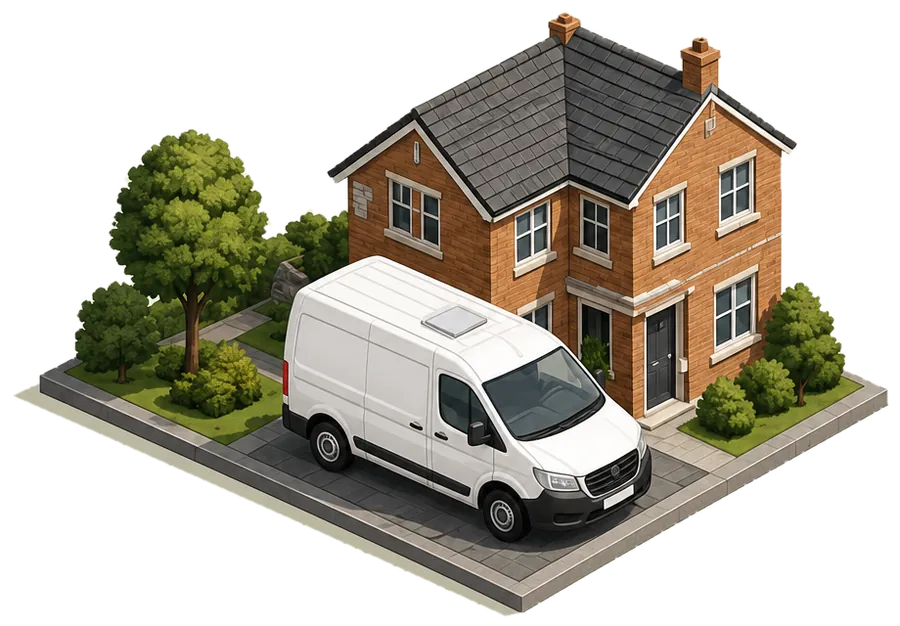
A sun tunnel quote covers three zones. The first is the roof: the dome, the base it sits on, and the flashing that keeps water out where the dome meets your tiles, slates or flat roof covering. The second is the void between roof and ceiling, where the tube runs. The third is the ceiling itself: the diffuser, the cut-out, and the finishing around it.
Each zone has its own labour and its own materials, so a sound quote lists them separately. If a quote shows one line that says only sun tunnel, you cannot see what is in it. You cannot compare it with another quote either, because you do not know whether the ceiling is finished, whether the flashing is matched to your roof or whether the tube length has been measured.
We give a free survey before any figure is written down. Then the quote is fixed and written down, and the figure holds when the crew arrive. Everything below is what the surveyor looks at, so that nothing surprises either of us later.
Tube length: the biggest single variable
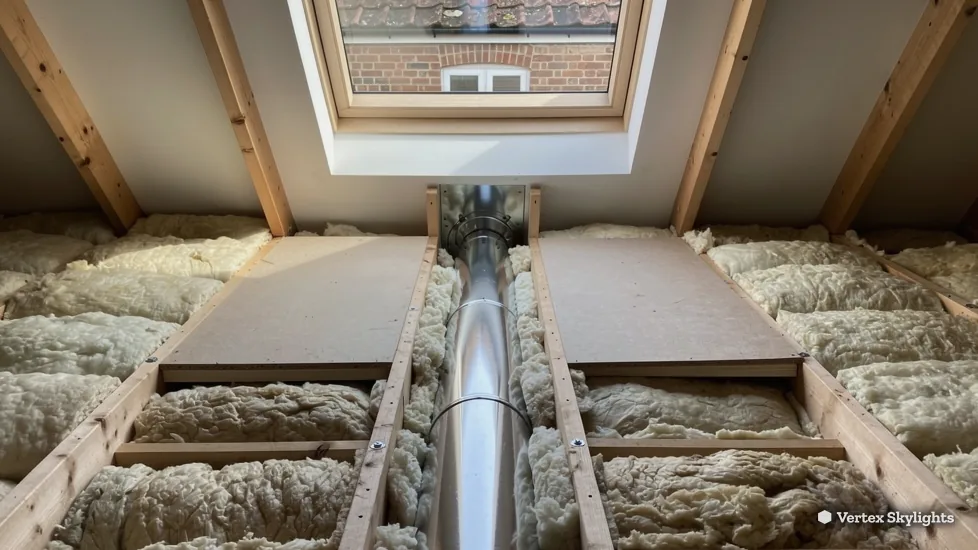
The tube is the heart of a sun tunnel, and its length is where the quote starts to differ from house to house. A short run between a shallow loft and a landing ceiling needs little tube. A tall roof space, or a run down through a floor of rooms, needs much more.
Length matters twice. Longer tube means more material and more time in a cramped loft. It also means the light has further to travel, and every extra stretch of tube gives up a little of the daylight it carries. So a long run sometimes calls for a wider tube, or for a different kind of tube, to keep the room bright enough to justify the work. Those choices change the parts list, and the parts list changes the quote.
The surveyor measures the run from the roof surface down to the ceiling, then looks at what sits in the way. Rafters, ducts, cables, a water tank and insulation all have to be dealt with. None of that can be judged from the street, which is why the survey comes before the figure.
Rigid tube or flexible tube
Sun tunnels use one of two kinds of tube. Rigid tube is a straight, mirror-finished section, and it carries daylight furthest because the light bounces off a smooth surface. Flexible tube is a ribbed, foil-lined tube that can bend round obstacles, and it is the answer when the route is not straight.
Neither is better in every house. Rigid suits a direct run from roof to ceiling. Flexible suits a loft with a beam or a duct in the way. Flexible tube is more forgiving to fit but carries a little less light over the same length, so it is best kept short. The right call depends on the route the survey finds, not on a preference.
Rigid tube is joined from sections, and an elbow adapter lets a rigid run turn through a set angle. A mix suits an awkward route: rigid where the path is straight, flexible for the last stretch. A quote should name which you are getting, and where, because the difference shows up in how bright the room ends up as well as in the cost.
| Tube | Suits | Strength | Know |
|---|---|---|---|
| Rigid, straight | A direct run | Carries light furthest | Needs a clear route |
| Rigid with elbow | One turn in the loft | Keeps a bright finish | Adds a part to fit |
| Flexible | A route with obstacles | Bends round beams | Keep the run short |
| Mixed | A long or awkward run | Uses each where it fits | Quote should say where |
Bends and the route through the roof space
A straight tube is the simplest thing to price. A bend adds a part, adds fitting time and takes a little light out of the run. Two bends take a little more. The surveyor may suggest moving the position of the dome or the diffuser a short distance to straighten the run, because a better route is simpler to build and brighter to live with.
Moving the position has a limit. The diffuser has to sit where the room needs light, and the dome has to sit on a part of the roof where it can be flashed properly. Between those two points sits the structure of your house: rafters, ceiling joists, perhaps a purlin. The tube has to find a path through the gaps, and the opening in the roof and ceiling may need extra timber framing to keep the structure sound.
That framing is a line of its own. Where the cut-out sits between rafters or joists, it is quick. Where a timber has to be trimmed, the opening needs a framed edge, and that takes longer. Ask the surveyor to point out which case you have, and write it into the quote.
The roof covering decides the flashing
Where the dome meets the roof, water must be turned away without fail. That job is done by a flashing, a shaped sheet or kit that sits under and over the roof covering round the base of the dome. Different roof coverings need different flashings.
Plain tiles, interlocking tiles, slates and flat roof membranes each have their own kit and their own way of being fitted. A tiled roof means lifting tiles around the opening and relaying them over the flashing. A slated roof is more delicate work, because slates must be handled with care. A flat roof needs an upstand, with the dome fixed to it and the membrane dressed up against it. A flat roof sits at a slight fall, and the upstand has to respect that.
The covering also affects how long the roof work takes, which is why two houses with the same tube length can be quoted differently. If you are not sure what your roof is covered with, the survey will tell you. If you are planning a new roof soon, say so, because timing the sun tunnel with the roofing work can save disturbing the same area twice.
The ceiling end and the finish inside
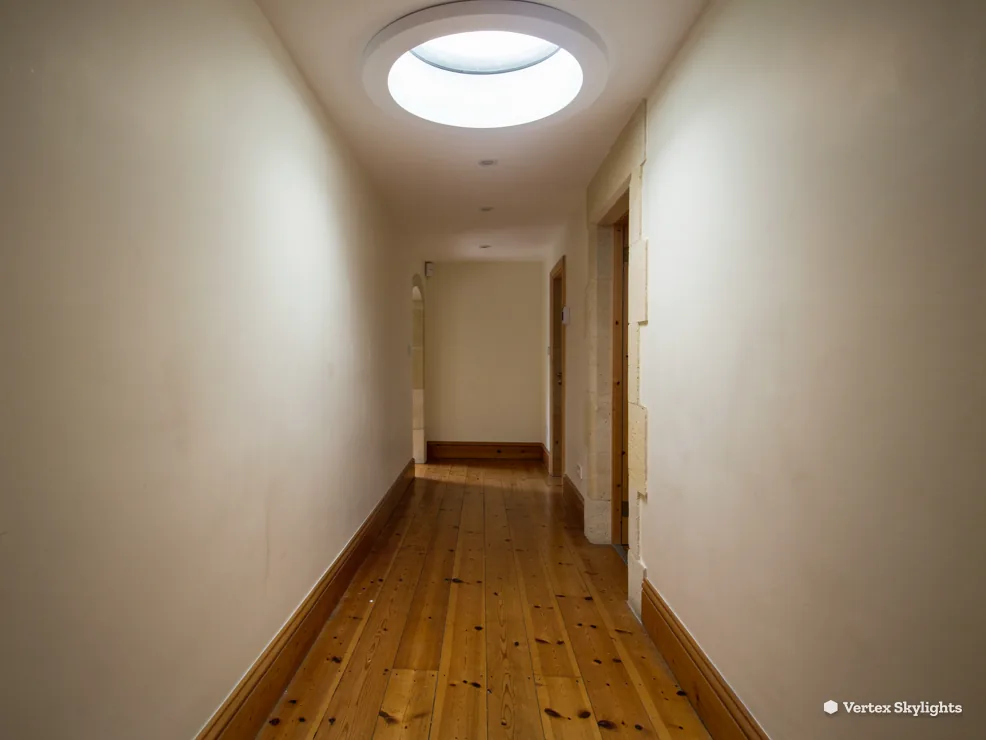
At the bottom of the tube sits the diffuser, a glass or plastic dish that spreads the daylight into the room. Fitting it means cutting a round hole in the ceiling, which is dusty and fiddly work, then finishing the edge so the opening blends into the room.
The finishing is where jobs differ most in quality. A tidy install leaves a neat ceiling, a clean edge round the diffuser and no dust in the room when the work is done. A plasterboard ceiling needs the cut made cleanly and the opening made good. A lath-and-plaster ceiling in an older house needs more care, and may need a skim or filler to keep the finish sound. A textured or coved ceiling has its own challenges.
We work tidily and leave the inside finished. That is part of the fixed quote, not an extra. It is worth asking any firm the same question, because a sun tunnel with a rough ceiling edge looks like a mistake every time you look up.
Words you will see on a quote
Dome
The clear cap fitted on the roof to gather daylight.
Flashing
The shaped sheet that makes the joint between dome and roof watertight.
Upstand
A raised frame on a flat roof that the dome is fixed to.
Diffuser
The glass or plastic dish set into the ceiling to spread the light.
Rigid tube
A straight, mirror-lined section that carries light furthest.
Flexible tube
A bendable, foil-lined tube for routes with obstacles.
Extras that change the price
A basic sun tunnel brings in daylight and nothing more. Several additions are available, and each changes the parts list.
Ventilation. Some units can be fitted with a way to move air as well as light, which suits a bathroom or a hallway that gets stuffy. It is a different product, with different parts, so tell the surveyor early if fresh air matters to you.
Electric light. A light kit fitted in the tube lets the same diffuser glow at night. It needs a power supply run to the loft, so the electrics become part of the job.
Blinds and shades. If a room is used at night or by a light sleeper, a way to shut off the daylight is worth thinking about at the start rather than as an afterthought.
Insulation and condensation control. The tube passes through a cold roof space, so it is wrapped or sleeved to stop moisture forming. Where the tube is long, this matters more, and the quote should show it.
None of these is essential. They are choices, and a clear quote lists them as options so you can see what each adds, then decide.
Replacing an old unit
Some sun tunnels are not new at all. An older unit may have a dome that has gone brittle or yellow, a flashing that has let water past, or a tube that has come loose. Replacing it is a different job from fitting a new one, because an opening is already there.
That does not mean the quote is simply smaller. The old unit has to be removed cleanly, the opening checked for damp or rot, and the flashing renewed to match the roof as it stands now. If the old unit was a different size from today's, the opening may need adapting. The tube inside the loft is worth replacing too, because a dull or stained tube will dim a bright new dome.
We install and replace. A survey will tell you whether the existing opening can be reused, and the fixed quote shows exactly what is being swapped.
Building Regulations and the paperwork
A sun tunnel in an existing home is a small job, but it is still building work. Current Building Regulations apply to the installation; for notifiable work, we file the Building Control notification, so there is nothing to chase.
The thermal side matters. Part L of the Building Regulations sets a limit for rooflights in existing dwellings, set out in Approved Document L, Table 4.2: 2.2 W/m²K for a rooflight. A sun tunnel dome and tube is a rooflight in this sense, so the product chosen has to meet that standard. This is one more reason to leave the specification to the survey rather than buy a unit on price alone.
For a wider look at the planning side of roof glazing, read the planning guide for skylights in Milton Keynes. It covers when permission is needed and where the council's planning team can confirm your own position.
Getting a fixed figure and comparing quotes
When you collect quotes, set them side by side and read for the same things. Is the tube length stated? Is the tube rigid, flexible or mixed? Is the flashing matched to your roof covering? Does the price include finishing the ceiling and making good inside? Is the guarantee in writing?
A low figure that leaves out the ceiling finish, or that assumes a straight run the survey has not confirmed, is not a lower price. It is a smaller job described in fewer words. The reverse is also true: a high figure should show you what it buys.
Our process keeps it simple. We survey for free, look at the roof and the loft, measure the run, then write one written figure, fixed before the crew arrive. Fitting a typical unit is usually one or two days, and the work carries a 10-year workmanship guarantee in writing. If you would like a figure for your own house, book a free survey. Our general costs guide explains how every quote is built.
Before you ask for a quote
- Which room needs the daylight, and how high is the ceiling?
- Can you see into the loft, and is the route clear?
- What covers the roof above that room?
- Do you want ventilation or an evening light too?
- Is the existing unit being replaced, or is this a new opening?
Reading the light, not just the line total
It helps to remember what you are buying. A side window looks out at a fence, a wall or the neighbour's tree. A sun tunnel looks straight up, and the sky overhead is the one view nothing blocks. That is the whole idea behind a tube: it carries that open view of sky into a room with no outside wall at all.
So a quote is only good if the tube will carry enough light to the place you want it. A hallway, landing or bathroom that sits under a pitched roof is the classic case. If the room lies under a floor of other rooms, the route may be too long to be worth it, and the better answer may be a roof window or a lantern elsewhere. We will say so at the survey.
For more help placing a unit, read where sun tunnels work best, or see the daylight answer. If you are weighing it against other glazing, is a sun tunnel the same as a roof window lines up the two side by side.
Cost questions answered
Why can nobody give an exact sun tunnel cost without a visit?
Because the tube length, the route through the loft, the roof covering and the ceiling finish all change the job, and none can be judged from the street. A visit and a measure turn those unknowns into a fixed written quote.
Does a longer tube cost more?
Yes. More tube means more material and more fitting time, and a long run may call for a wider or different tube to keep the room bright. The surveyor measures the run before any figure is written.
Is the ceiling finish included in the quote?
With us it is. The diffuser is fitted and the inside is finished before we leave, as part of the fixed quote. Check that any other firm includes it too.