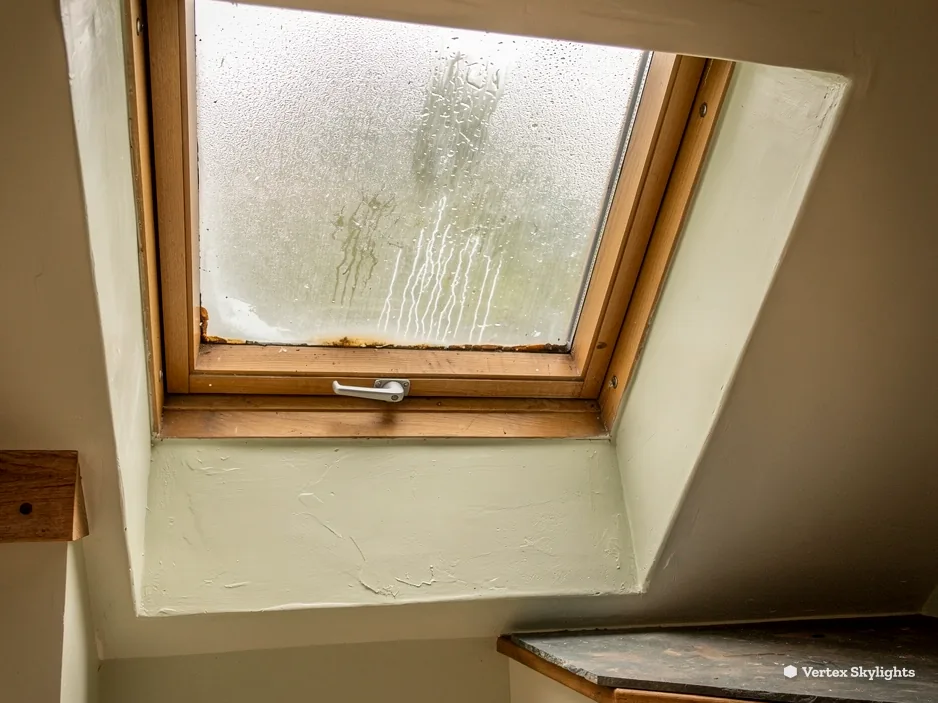
We tend to notice a rooflight when it stops being clear. A pale haze appears in one corner, then a fine film of droplets, then a cloud that comes and goes with the weather. You wipe the inner pane and nothing changes. You go up a ladder and wipe the outer pane and nothing changes either. The water is trapped between the two sheets of glass.
That is a misted rooflight, and the cause is one kind of thing: the sealed gap that was built to stay dry has let moisture in. This guide explains how the unit is made, how the seal fails, what the weather and the building have to do with it, and how to tell it apart from the ordinary condensation that forms on a cold pane.
The aim is that you can look at your own skylight, name what you are seeing and decide what to do next. If you would rather have it looked at, a free survey is the quickest way to know.
What is actually inside a double glazed rooflight
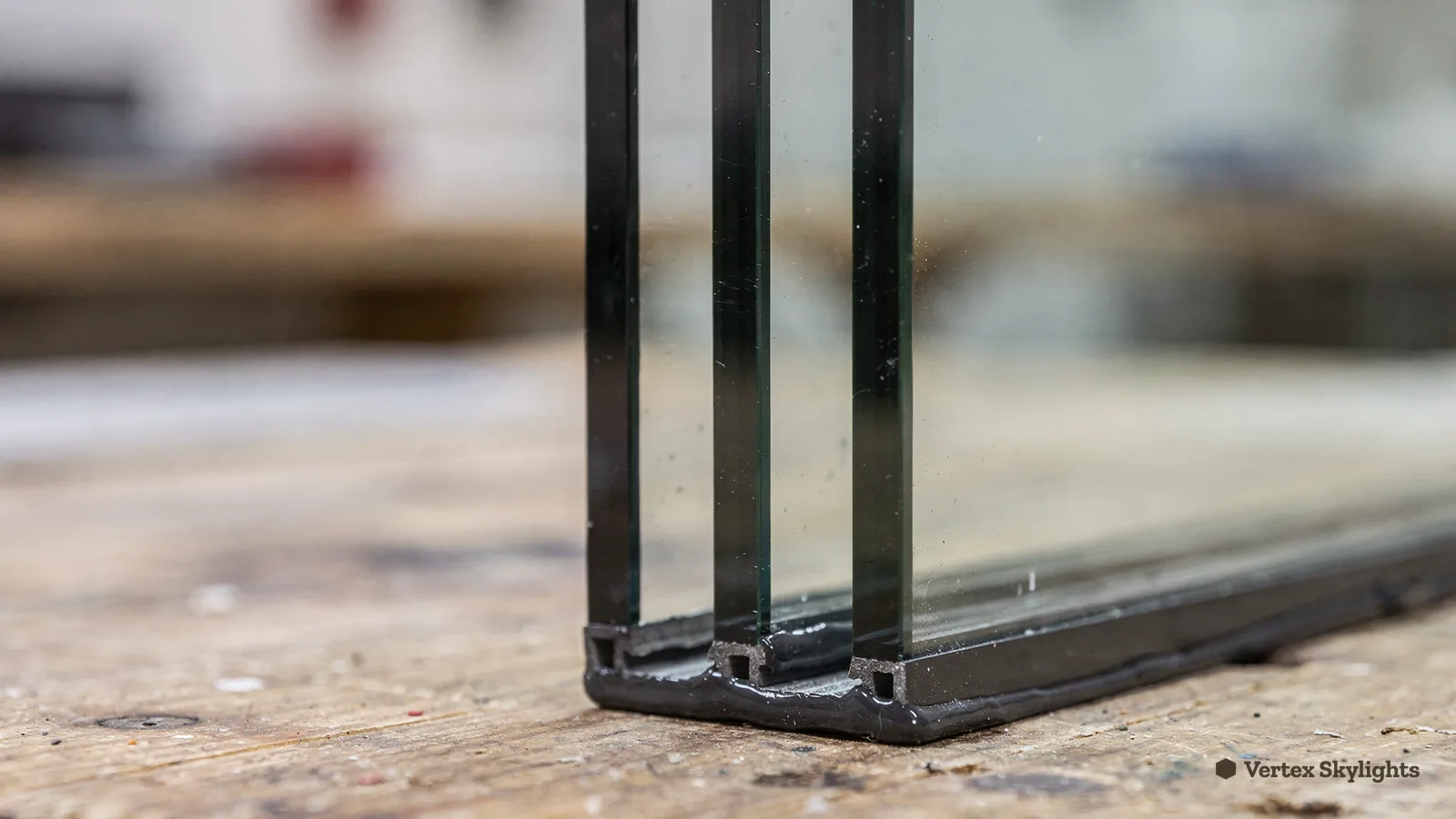
A modern rooflight or roof window does not hold two loose sheets of glass. It holds a sealed unit: two panes (sometimes three) separated by a thin metal or composite spacer bar that runs around the edge. The gap between the panes is filled with dry air or an insulating gas, and the spacer is packed with a drying agent, a desiccant, that soaks up any trace of moisture left from manufacture.
Around the outside of the spacer sits the edge seal, a bead of sealant that bonds the panes to the spacer and keeps the gap closed. The whole unit is then bedded into the rooflight frame or sash, and the frame is what you see from the room.
- Panes: the glass you look through
- Spacer bar: holds the panes the right distance apart
- Desiccant: dries the trapped air
- Edge seal: keeps the gap closed from the outside
When all four are doing their job, the gap stays dry for the life of the unit and you never think about it. Misting starts when one of them stops.
How the seal fails
The edge seal has a hard life. It is bonded to glass on one side and to a metal bar on the other, and those materials swell and shrink at different rates. Every sunny day pulls them one way, every cold night the other. Over many seasons that movement works at the bond until a hairline path opens between the outside air and the gap.
Once the path exists, moisture follows. Warm, damp air is drawn in when the unit cools overnight, because the air in the gap contracts and the outside air is pulled in to make up the difference. The desiccant takes what it can, and for a time the unit looks fine. When the desiccant is full, the moisture has nowhere to go and condenses on the cold inner face of the outer pane. That is the cloud you can see.
A rooflight faces the sky, so its seal takes more of that cycling than a window set in a wall. It is exposed to sun at the height of the day and to a clear, cold sky at night. A skylight on a south-facing slope sees a wide daily swing; one in a shaded valley sees standing damp. Neither is a defect in the way you use the room. It is the position doing what the position does.
Heat, water and the position of the glass
Water is the other half of the story. On a pitched roof, rain runs off quickly, but a low-pitched roof window or a flat rooflight can hold a film of water against the seal after a shower. A flat rooflight stands on an upstand, its glass at a slight fall, so water clears, though leaves and silt can collect at the lower edge and keep that area wet.
Standing water softens some sealants over time. Frost does the opposite: water that finds a tiny gap freezes, expands and widens it. If you see misting start at the lowest corner of a sloping unit, that is where the water has been resting, and it points to the seal rather than to anything inside the room.
Heat matters too. Dark frames and dark glazing bars absorb sun and pass it into the spacer. Blinds fitted tight to the inner pane can trap warmth against the glass. None of this is wrong, but it is part of why two rooflights of the same age on the same house can mist at different times.
| What you see | Where it sits | What it points to |
|---|---|---|
| Haze in one corner | Between the panes | Early seal failure |
| Droplets that come and go | Between the panes | Seal open, desiccant filling |
| Permanent cloud or streaks | Between the panes | Desiccant full, seal gone |
| Wipes clean from inside | Room side of glass | Ordinary condensation |
| Wipes clean from outside | Roof side of glass | Dew or weather |
The age of the unit and the make of the frame
Seals do not last for ever, and neither do the sealants and spacers behind them. Older units were built with spacer bars and sealants that conduct more heat and move more. Newer units use warm-edge spacers and better-bonded seals, which reduces both heat loss at the edge and the stress on the bond.
The frame matters because it carries the unit. A timber, aluminium or PVC frame that has swollen, warped or lost its bedding can press unevenly on the glass. A rooflight that has been fitted slightly out of square, or whose frame has moved with the roof, puts a twist on the unit that the seal takes up every day.
Fitting also plays a part. A unit that was handled roughly, or a rooflight bedded in too tight, starts life with a seal already under strain. This is one reason a survey looks at the frame, the bedding and the flashings as well as the glass. Misted glass is the symptom; the survey is how we learn whether the cause is the glass alone or the way the whole rooflight sits.
Condensation on the glass, or between the panes?
Not every wet rooflight is a misted one. A cold pane in a warm, damp room collects water on the room-side face. That happens in kitchens, bathrooms and bedrooms on cold mornings, and it clears as the room warms and the air dries. It means the glass is cold and the air is humid. It does not mean the unit has failed.
A quick test tells you which you have. Wipe the inside face with a dry cloth. If the cloud wipes away and returns, it is on the room side. If it stays put, wipe the outside face from a safe position. If that is clear too, the water is in the gap.
Our short answer on this lives in Condensation on the Glass or Between the Panes?, which sets out the difference side by side. Ordinary room condensation is worth fixing as well, with ventilation, extraction and a rooflight that opens, but it is a different job from replacing a failed sealed unit.
Before you decide it is a failed seal
- Does the cloud stay when you wipe the room side?
- Is the outer pane clear when seen from outside?
- Is the haze fixed to one edge or corner?
- Does it return on mild, dry days as well?
Room moisture and ventilation
The room does not cause a sealed unit to fail, but it does decide how fast the problem shows and how bad it looks. A kitchen with a hob and kettle, a bathroom with a shower, a loft bedroom with several sleepers, all load the air with water vapour. Warm air rises, so that vapour gathers at the ceiling and meets the coldest surface in the room, which can well be the rooflight.
If the frame and the room-side seal are weak, vapour can also be pushed into the edge of the glass unit itself. A rooflight in a steamy room is under more pressure than the same rooflight in a spare bedroom.
Good ventilation helps whatever the glass is doing. Extraction in the kitchen and bathroom, a trickle vent or an opening rooflight, and a dehumidifier in a damp room all lower the load. They do not undo a failed seal, but they stop ordinary condensation from making the picture look worse than it is. An opening rooflight also lets stale air out at the very top of the room, which is the one place a side window cannot reach.
It follows from the same idea that makes straight up so clear: the sky overhead is the view nothing blocks, and the ceiling is where the air gathers.
What happens if you leave it
A misted rooflight is a nuisance before it is anything else. The view goes first. A cloudy pane over a kitchen table, a staircase or a bed takes the clear sky out of the room, and the whole point of fitting glass overhead is lost.
The insulation value of the unit also falls once the gap is no longer dry and sealed. The gas fill, if there was one, leaks out as moisture comes in, and the unit loses much of what it was built to do. You may notice the room feels cooler near the glass, or that condensation on the room side forms more easily.
Over a longer time, standing water between the panes can stain the glass and mark the spacer. Some deposits cannot be cleaned even when the unit is opened. For that reason it is worth acting while the rooflight is still only a little cloudy, not when the stain has set. We cover whether this is a safety question in Is a Misted Rooflight a Problem?.
Can the water be removed?
The next question is whether the water can be removed. Drilling a hole to let the moisture out, or injecting a drying agent, cannot restore a sealed unit. The seal has already opened, and moisture will return. A drilled unit also keeps a hole in the glass, which weakens the pane.
The lasting answer is to replace the sealed unit, or, where the frame or the flashings are also tired, the whole rooflight. That choice is the subject of Replacing a Misted Rooflight: Unit or Whole Rooflight; whether the glass alone can be swapped is covered in Can Misted Rooflight Glass Be Replaced?.
On a survey we measure the existing unit, note the make and the glazing build, check the frame, the bedding and the flashings, and tell you plainly which route suits the rooflight. You then receive one written quote, set before the work starts and held on the day.
Lasting units and how to look after them
You cannot stop a seal ageing, but you can avoid shortening its life. Keep the outer glass and the lower channel clear of leaves and debris so water can run off. Clean the glass with water and a soft cloth, not with abrasive pads or strong solvents, which can mark the glass and creep into the seal. Check blinds sit clear of the pane. Keep the room ventilated.
When a unit is replaced, a new warm-edge sealed unit starts with a fresh seal, and a 10-year workmanship guarantee in writing covers the installation. When a whole rooflight or roof window is replaced, the new product goes in to current Building Regulations, and any Building Control notification the work needs is handled by us.
Part L of the Building Regulations, Approved Document L, Table 4.2, sets the limits for existing dwellings when a window or rooflight is replaced: roof windows at 1.4 W/m²K or WER band B, and rooflights at 2.2 W/m²K. A new unit is chosen to meet them, and the wider picture on heat loss sits in energy efficient rooflights.
Two limits a replacement is measured against
- 1.4 W/m²K
- roof window limit, Part L Table 4.2, or WER band B
- 2.2 W/m²K
- rooflight limit, Part L Table 4.2, existing dwellings
Quick answers about clouded skylights
Will a misted skylight clear up by itself?
A little haze may thin out on a warm, dry day, but once the seal has opened the moisture comes back. The unit does not seal itself again, so the cloud returns as the weather changes.
Is the cause the same on every make of rooflight?
The cause is the same kind of failure, the edge seal of the sealed unit letting moisture in. The make, the age and the position change how soon it shows. A VELUX roof window and a flat rooflight built from a different system both rely on the same sealed-unit idea.
Do I need a survey to know what is wrong?
The wipe test tells you whether the water is between the panes. A free survey tells you whether the unit alone has failed or whether the frame and flashings need attention too. Send a photo on WhatsApp on 07880 284133 or ask for a quote.