A clouded pane asks a plain question. Do you need new glass in the frame you have, or a new rooflight from the roof up? Both are real answers, and each suits a different set of circumstances. The right one depends on the age and condition of the frame, the flashings round it, the make of the rooflight and what you want the room to do next.
This guide sets out the two routes side by side, then walks through the survey, the measuring, the order of work and what you can expect on the day. If you are still working out why the glass clouded, start with our explanation of why rooflights mist up between the panes, then come back here.
Everything below is part of the wider misted rooflights service, which also covers roof windows, flat rooflights and lanterns.
The two routes in plain terms
Route one is a sealed unit replacement. The failed double glazed unit is removed from its sash or frame and a new unit, made to the exact size, is fitted in its place. The frame, the flashings and the inside finish stay as they are. For a skylight whose frame is sound, this is the lighter job.
Route two is a whole rooflight replacement. The old product is taken out, including its frame and, where needed, its flashings, and a new rooflight or roof window is fitted in the opening. The new product arrives with new glass, new seals and a new frame, so the whole thing starts fresh.
The two routes also differ in what they leave behind. A unit swap leaves the outside of the roof untouched, so the weathering you already have stays exactly as it is. A whole replacement disturbs the roof round the opening, which is why the flashings are renewed with it and the covering is made good to meet them. Think of it as a choice between a light touch and a fresh start.
Neither route is better in itself. The better one is the one that fits what the survey finds. We say which in writing before any work begins, and the quote is fixed.
| New sealed unit | Whole rooflight | |
|---|---|---|
| What changes | Glass only | Glass, frame, seals |
| Frame must be | Sound and square | Any condition |
| Flashings | Stay in place | Renewed or refitted |
| Roof opening | Unchanged | Can be altered |
| Fresh start for seals | Glass seals only | All seals |
When a new sealed unit is enough
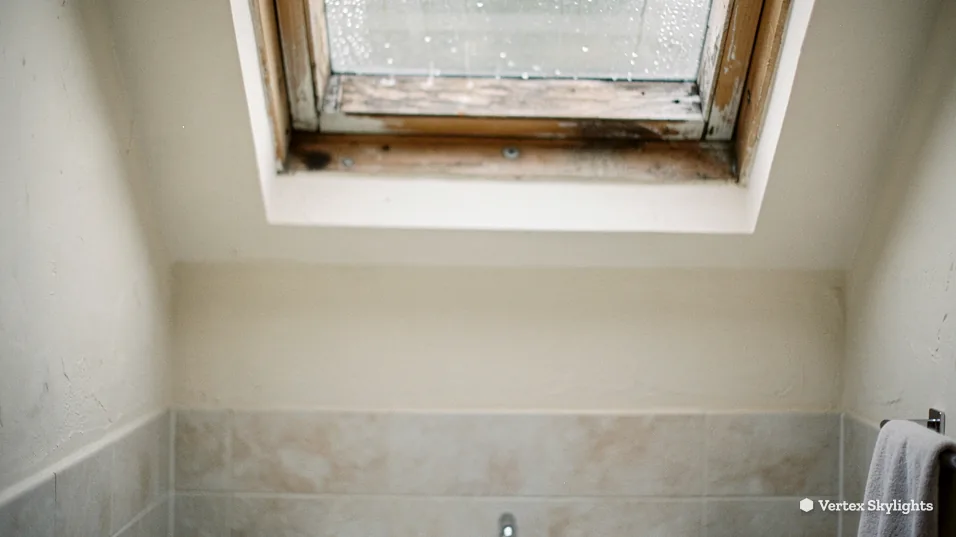
A new unit makes sense when the frame is in good order and the only fault is the glass. The signs are straightforward: the timber or aluminium is sound, the sash opens and closes as it should, the seals round the frame are intact, the flashings sit tight and there is no sign of damp in the reveal or on the plaster below.
It also makes sense when the make of the rooflight is a common one with a current glazing range. A VELUX roof window, for example, is built to a size code, and replacement glazing is made to suit the sash. The unit can be chosen to match the frame, and it can be a better specification than the one it replaces, with a warm-edge spacer and a coated inner pane.
Because the rooflight is not removed, the room stays tidier and the job is shorter. The inside finish is left alone, and the room stays clean and ready for use.
When the whole rooflight should go
A new unit in a tired frame is a poor use of good glass. If the frame has swollen, split or lost its paint, if the sash no longer closes square, or if the flashings have lifted, the new unit inherits the strain that ended the old one. Replacing the whole rooflight resets all of it.
Whole replacement is also the sensible route when the rooflight is old enough that matching glass is hard to source, when the product has been discontinued or when it was never a good fit for the opening. A flat rooflight with a tired kerb, a roof window that leaks around its flashings or a plastic dome that has yellowed and gone brittle all fall into this group.
- Frame swollen, warped or splitting
- Sash that does not close square
- Flashings lifted or failing
- Glazing discoloured or brittle
- No current glazing for that make
If you are weighing up size or a change of type at the same time, a whole replacement is the moment to do it. A fixed unit can become an opening one, a plain pane can become a laminated one and a dome can become a flat rooflight.
What the survey looks at
The survey costs nothing, and the decision is made there. We look at the rooflight from inside and out, and we measure.
Inside, we check the reveal and the plasterwork for damp or staining, how the sash closes, the state of the seals and the condition of the finish. Outside, we look at the flashings, the weathering round the opening and the state of the roof covering where it meets the rooflight. We measure the glass unit itself, its overall thickness and the sash opening, and we note the make and any size code.
On a flat roof we look at the upstand, the fall of the glass and how the roof edge drains. We also look at what is above: a tree, a gutter or a neighbouring wall that drops leaves and silt onto the glass.
You get a written quote that does not change on the day. If we find the frame needs more than the glass, the quote says so and shows the whole-rooflight route as well.
What to have to hand for the survey
- A photo of the clouded rooflight from inside
- Any label or marking on the frame
- Which room it lights and how it opens
- Whether the glass has tinting, blinds or a motor
Measuring and making to measure
Sealed units are made to measure. The unit has to match the sash size to the millimetre, with the right thickness, the right spacer and the right glass build. A unit that is a few millimetres too thin will rattle, and one that is too thick will not close.
That is why the measuring is done on site and not from a photograph. On a VELUX roof window the size code on the frame, such as MK04, gives the overall size: the letter is the width and the digits are the height. That tells us which product it is, but the glazing unit inside the sash still gets measured directly.
Bespoke sizes and unusual shapes are made to order. Flat rooflights, pyramid and dome units and rooflights set in aluminium frames each have their own build, and a made-to-measure unit allows for it. The order is placed once you have accepted the quote, and the date for fitting is agreed with you. Lead times depend on the glass build, so put the question to us when we measure and the answer comes before you commit.
Glass choice when you replace
Replacement is a chance to improve the glass. The choices are practical, and each answers a question about the room.
- Warm-edge spacer: reduces heat loss at the edge and eases the strain on the seal
- Low-emissivity coating: keeps room heat in
- Laminated inner pane: holds together if it breaks, which suits a rooflight over a stair or a bed
- Toughened outer pane: stands up to weather and impact
- Solar control or tinted glass: cuts glare and heat gain on a sun-facing slope
- Noise-reducing build: calms rain on the glass
Part L of the Building Regulations, Approved Document L, Table 4.2, sets the limits for existing dwellings: roof windows at 1.4 W/m²K or WER band B, and rooflights at 2.2 W/m²K. When a whole roof window or rooflight is fitted, it is chosen to meet them. For the thinking behind those numbers, see energy efficient rooflights.
What the replacement glass is measured against
- 1.4 W/m²K
- roof window limit, Part L Table 4.2, or WER band B
- 2.2 W/m²K
- rooflight limit, Part L Table 4.2, existing dwellings
Blinds, motors and openers
A rooflight with a blind, a motor or a rain sensor has more parts to think about. The blind is clipped or fixed to the frame and needs lifting off for the glass to come out. A motor or remote opener runs through a cable that stays connected to the controls, and a rain sensor closes the sash when the weather turns.
On the day, we remove the blind, refit it afterwards and check it runs as it should. If the rooflight is electric, we test the opener and the sensor before we leave. Where a whole electric rooflight is replaced, the controls are wired in or paired with the new unit. If you would like a blind or a motor added at the same time, tell us at the survey and it goes into the quote. See electric opening rooflights for what is available.
What the day looks like
Fitting is usually one or two days for a typical rooflight. A sealed unit swap is the shorter end of that; a whole rooflight with new flashings takes longer. We confirm the number of days in the quote.
The order of work is the same each time.
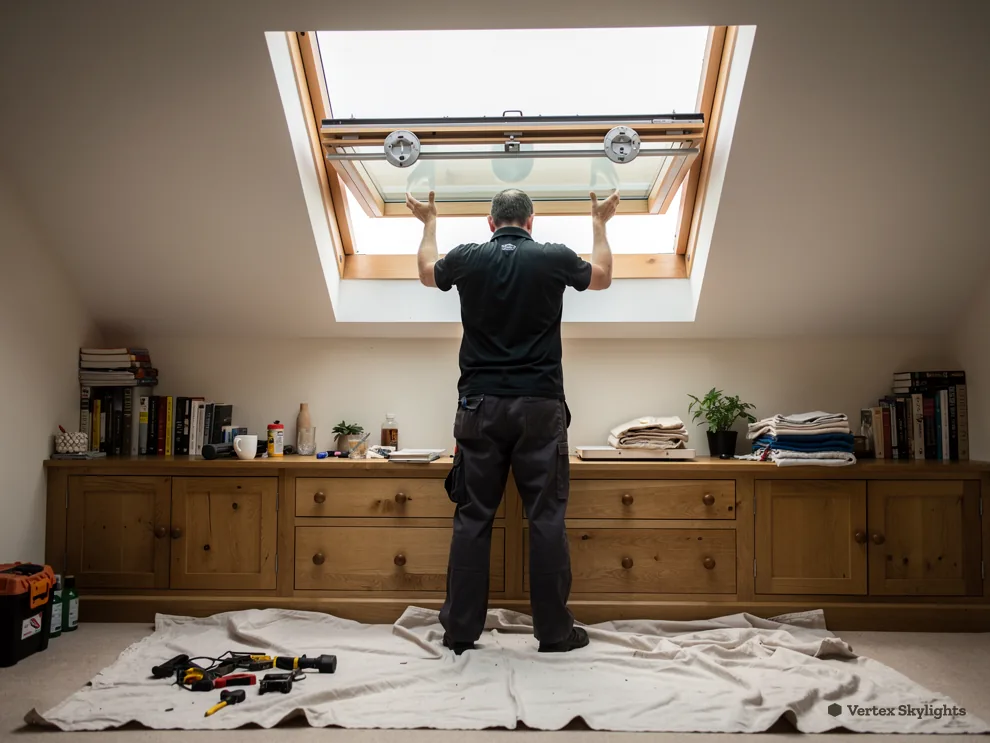
- Protect the floor and furniture below, and set up access to the roof.
- Remove the blind, the sash or the old rooflight.
- Fit the new unit, or prepare the opening and fit the new rooflight.
- Dress the flashings and make the roof weathertight.
- Make good the inside, with the finish tidied round the reveal.
- Test the opening, any motor and any blind, and clear up.
Where the opening is altered, for a larger rooflight or a new position, the structure is trimmed to suit and the plasterboard and finish are made good. Notifiable work is covered by a Building Control notification that we make, and the installation is to current Building Regulations. Planning is not usually the question for a like-for-like swap; our planning guide explains where it can be, and the council's planning officers can confirm for your street.
The guarantee and what comes after
Every replacement carries a 10-year workmanship guarantee in writing. It sits alongside the maker's own guarantee on the glass or the product, and you get both in writing. Read our guarantee for the full wording.
After the job, a few habits keep the new unit clear. Rinse the outer glass when it gathers dust. Keep the lower channel and any flat roof gutter free of leaves. Wipe room-side condensation off on cold mornings, and ventilate. Those habits cost nothing and they lengthen the life of any sealed unit. A new unit has the best chance of a long clear life when the rooflight around it is also dry, square and well ventilated, so it is worth looking up at it now and then, in daylight, and noting any new haze while it is still small.
If you still wonder whether the glass alone can be changed, the short answer is covered by Can Misted Rooflight Glass Be Replaced?. Whenever you like, ask for a free survey or send a photo on WhatsApp on 07880 284133.
Before you choose a route
Can I replace just one misted unit in a pair of rooflights?
Yes. Each rooflight has its own sealed unit, so only the clouded one needs to be changed. The survey notes the other so you know where it stands.
Will the new rooflight match the old frame?
A sealed unit swap keeps your frame, so the outside look stays the same. A whole replacement lets you choose a frame colour and finish that suits the roof and the room.
Does the inside get messy?
We protect the floor, keep the work contained and finish the inside after the fitting. The reveal is made good and the room is left clean.